Showing posts with label visual space. Show all posts

Tuesday, April 9, 2013

131: DW Meinig's Interpretation of Ordinary Landscapes

The Interpretation of Everyday Landscapes: Geographical Essays is a collection of landscape studies edited by DW Meinig.  It represents a conscious effort to complicate the cultural landscape and reclaim it from the abstractions of science, in a way that both respects the visual nature of landscape and takes advantage of its discursive possibilities.

In his Intro, Meinig defines an ordinary landscape as a continuous surface created by and through the "routine lives of ordinary people."  But it's also not that simple: landscape is a coherent unity of physical, biological, and cultural features; it has both functional and aesthetic components; it is more visual and panoramic than an environment, but less subjective and experiential than a place; and it is both a geographical formation and a representation, a history and a text, a symbol and an accretion of meanings.  Landscape is both space and meaning; it doesn't exist without interpretation.

The essays in this collection generally support Meinig's rather complex definition of landscape as a field of study.  A few highlights:

Monday, April 8, 2013

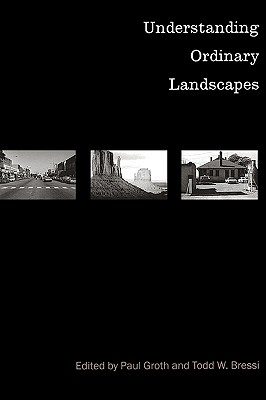
126: Groth & Bressi's Understanding Ordinary Landscapes

The essays in Paul Groth and Todd Bressi's collection Understanding Ordinary Landscapes are compiled from a two-day symposium at Berkeley in 1990 called "Vision, Culture, and Landscape" that was intended to both celebrate and critique JB Jackson's version of cultural landscape studies.  In general, while the essays underscore Jackson's reliance on and use of visual and spatial information as a way to understand past and present cultures, they grapple with ways to deal with the realities of social and cultural pluralism and their effects on the landscape.  While in many ways Jackson's work was radically subjective and Postmodern before its time, in others it is distinctly Modern, particularly in its emphasis on underlying universals, empirical research, and continuity.

According to Groth, cultural landscape studies defines landscape as the combination of people and place, with an emphasis on the history of how people have used everyday or vernacular space - buildings, rooms, streets, fields, yards - to establish and articulate identities, social relations, and cultural meanings.  When JB Jackson started publishing Landscape in 1951, he also emphasized the activist mission of cultural landscape studies: the more people know about ordinary environments, the more they will become attached to them and the less likely they will be to wantonly destroy them.  Groth and Bressi build on cultural landscape studies via a 6-part framework updated for the 1990s:

  1. focus on ordinary landscapes to get at cultural meaning and environmental experience
  2. shift from a rural emphasis to both rural and urban landscapes, as well as landscapes of production and landscapes of consumption
  3. continue to study diversity and uniformity, but emphasize difference, fragmentation, intertextuality and hybridity instead of a single, unifying narrative
  4. continue to write for the intelligent lay reader
  5. support a broad notion of interdisciplinarity that includes cultural, human, social, critical, landscape architecture, art history and other approaches
  6. engage with visual and spatial information, either in support of or in direct opposition to it; the landscape must remain the primary object of study.  Respect JB Jackson's argument that "landscape... must be regarded first of all in terms of living rather than looking."
This collection includes many heavyweights: David Lowenthal, Peirce Lewis, Dolores Hayden, Wilbur Zelinsky, and more - all folks who are contributing to and thinking about what a new cultural geography might mean and how it might be updated to include social difference and PoMo cultural theory.  It also holds up JB Jackson as the methodological exemplar of cultural landscape studies - which makes sense, because as far as I know, he invented it.

Sunday, April 7, 2013

102: Henri Lefebvre's The Production of Space


Lefebvre was one of the very first orals books I read.  My notes from a year ago: 

Henri Lefebvre’s vast, multifaceted The Production of Space could probably be said to advance any number of arguments, but I think his most compelling argument is the one that brings space and knowledge into a classical Marxist framework: capitalist Western society is moving from the production of things in space to the production of space itself, which means that capitalist powers are increasing their hold and surveillance on ordinary people (aka space is now shaping the working class).  However, all is not lost: no matter how much they try, the people who build and shape “dominant” space and employ the working class can’t squeeze the working class out of existence or keep them from “appropriating” and shaping space to suit their own needs, nor can they make the world a completely visual, timeless, ideological construct.  Regular people have bodies, and we live in specific places at specific historical moments, and we shape those places (yeah, I said places, not spaces) into unique, historical “works of art” that contrast with the partially commodified built environment constructed by the ruling class.  To say that capitalism has moved beyond the product to space itself is to argue for both an increasing attempt at totalizing control of society through space AND increased resistance from the people who live in, experience, and shape that space – with the potential for a socialist revolution where appropriated spaces based on the human body/lived experience and use-value take precedence over dominant, visual spaces and exchange-value.