In Machine-Age Ideology: Social Engineering and American Liberalism, 1911-1939, John Jordan argues that early 20th century "rational reform" was the product of the top-down, antidemocratic, technocratic politics of the machine age, and thus American liberal reformers in this era became less interested in helping the poor gain their voices as citizens than in engineering and controlling society. Jordan's cultural history, which relies primarily on the papers of reformers, statements and theories of prominent engineers, writers, and academics, and popular lit sources, shows how technological language and notions of Progress, control, and hierarchy filtered into social reform and the institution of liberalism as a whole.
Jordan divides his study into three historical periods, each with its own reform projects. He locates the origins of rational reform (1880-1910) in Progressive reformers and sociologists like Veblen, who want to make the relationship between reformers and society less political and more like the relationship between engineers and nature. From 1910 to WWI, publications like Lippman's The New Republic and foundations like Russel Sage, the Rockefeller Foundation, and Carnegie Corp start arguing that "disinterested specialists" well-versed in social science and technology should lead the masses; Herbert Hoover called on manly men to be "officers in the great industrial army;" and Taylor and other efficiency experts made the efficiency craze visible.
Showing posts with label democracy. Show all posts
Friday, April 12, 2013
Monday, April 8, 2013
127: Dolores Hayden's Building Suburbia
Dolores Hayden's Building Suburbia: Green Fields and Urban Growth, 1820-1900, is an extended essay on the 180 years of metropolitan development in the US from the perspective of the "urban periphery." Taking a network approach to the history of suburban development, Hayden studies maps, town plans, housing designs, pictures of households, aerial photography and other sources for clues as to the particular configuration of real estate entrepreneurs; natural and built environments; the lives of women, children, and men; and class, race, and political orientations that went into the development of the suburbs, and she divines 7 distinct types, each with its own characteristic development practices, building techniques, marketing strategies, architectural preferences, and environmental attitudes. The resulting book is both a history of suburban development and a critique of suburbia; throughout, Hayden argues that the suburbs have historically reproduced the conflict between people who seek the "triple dream of home, nature, and community" and entrepreneurs who "search for profits through the development of greenfield sites." She thus brings the suburbs to the forefront of landscape studies and reconfigures them as a site of struggle over the realization of the American Dream.
Labels:
capitalism,
Cultural Geography,
democracy,
development,
history,
landscape,
network,
struggle,
suburbs
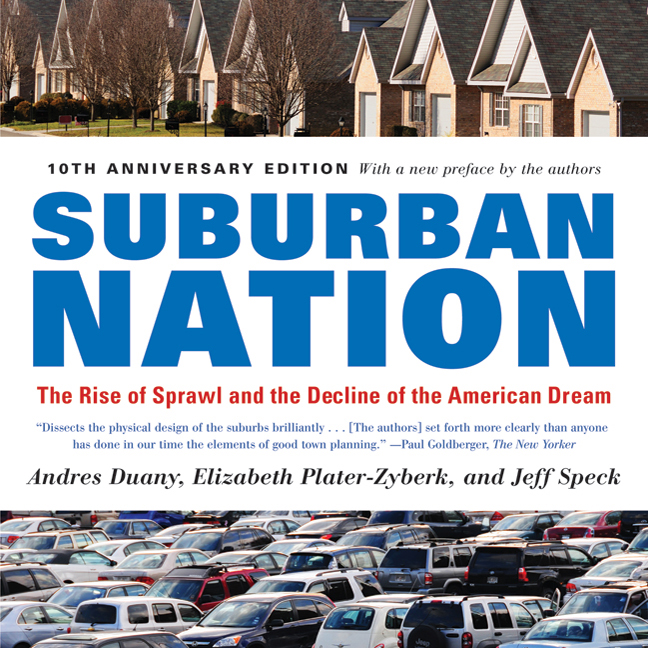
123: Duany, Plater-Zyberk & Speck's Suburban Nation
Despite its title, Suburban Nation: The Rise of Sprawl and the Decline of the American Dream, this book is only partially about suburbia; it also serves as a programmatic statement and justification for New Urbanist development. Andres Duany, Elizabeth Plater-Zyberk and Jeff Speck are architectural and city planners who designed the planned community of Seaside, Florida, and throughout Suburban Nation they argue that suburban sprawl is not bad because it is ugly. Rather, the authors (and their urban and suburban informants) argue that because there is a "causal relationship between the character of the physical environment and the social health of families and the community at large, suburbia is bad because it doesn't function to foster community and democracy. By contrast, communities modeled after "traditional American neighborhoods" can be aesthetically pleasing, make more efficient use of space, and cater to the needs of both individuals and the community.
114: Margaret Kohn's Brave New Neighborhoods
Margaret Kohn's Brave New Neighborhoods: The Privatization of Public Space argues that "public life is undermined by the growing phenomenon of private government" via the privatization of physical public spaces. As central business districts, parks, and other public gathering places are increasingly replaced with privately-owned shopping malls, gated communities, and Business Improvement Districts, true free speech and face-to-face political debate are foreclosed by bans on political speech or certain viewpoints (or even certain groups of people) on private property. As opposed to online forums, public space allows for debate in real time, among real, embodied people; it fosters the kind of informed opinions needed to keep a democracy running, so the loss of public space also has profound implications for the functioning of American politics.
Kohn bases her arguments in the historical uses of public space, legal cases regard the public/private status of malls, gated communities, and other privatized public spaces, and theories connecting physical spaces with political process. She argues that
Saturday, April 6, 2013
94: Doug Rossinow's Politics of Authenticity
With The Politics of Authenticity: Liberalism, Christianity, and the New Left in America, Doug Rossinow writes a history of the New Left that emphasizes continuity across both time and the broader political field of the 1960s. Unlike many scholars of the 1960s, Rossinow was not there; this is a much-needed history of the left from the outside. Instead of drawing on personal connections and personal experience, Rossinow relies on newspapers, TV, radio, and other media sources, as well as interviews, to understand the Left and place it in context. He argues that the New Left operated by applying an existentialist activism to the left; from this perspective, the New Left developed in response to the Cold War of the 1950s, and it ended partly because the seeds of identity politics within existentialism fragmented the Left after 1968.
84: Lizabeth Cohen's Town Center to Shopping Center
In "From Town Center to Shopping Center: The Reconfiguration of Community Marketplaces in Postwar America," Lizabeth Cohen shows that the shift in consumer spaces from downtown shopping districts to suburban shopping centers and malls threatens the public sphere on which democracy depends.
The new landscapes of postwar mass consumption had three major effects on American community life:
- by commercializing public space, they brought market segmentation, including divisions by race and class, to community life
- by privatizing public space, they privileged the rights of property owners over citizens' rights to free speech
- by feminizing public space, they gave women more of a claim to the suburban landscape, but they circumscribed their power by constructing them as consumers only
Thursday, April 4, 2013
64: Sean Wilentz' Chants Democratic
In Chants Democratic, New York City and the Rise of the American Working Class, 1788-1850, Sean Wilentz describes the process of "metropolitan industrialization" - aka the alienation of labor - and its impact on emerging class relationships in New York during the Jacksonian era. In particular, he's interested in the development of class consciousness among the city's artisans. Like other scholars indebted to E.P. Thompson and the new social history, Wilentz is profoundly interested in the whole lives and particularly the agency of his subjects, but he is careful to integrate the world of the artisans into a more traditional economic and political framework. He combines these micro/macro approaches to argue that class formation was critical to the social and political crises of the era.
Monday, April 1, 2013
37: Bernard Bailyn's Ideological Origins of the American Revolution (round 2)
Bernard Bailyn's The Ideological Origins of the American Revolution argues that the ideology of the American Revolution was based on the usual combination of Enlightenment thought, religion, English common law, classical literature, but also on the "peculiar strain of anti-authoritarianism bred in the upheaval of the English Civil War." Bailyn's critical intervention was that the Revolutionary generation were not a cabal of philosophical intelligentsia using Enlightenment principles to construct the ideal society; they were a bunch of real-world people operating within an ideology that had both British and American roots, and they overthrew British rule because this ideology led them to suspect a British conspiracy against liberty.
Bailyn comes to this conclusion by closely reading the pre-1776 pamphlets produced in the colonies regarding the "Anglo-American struggle" - political theory, history, polemics, sermons, correspondence, and poems - for the "assumptions, beliefs, and ideas - the articulated world view - that lay behind the manifest events at the time." Rather than focus on "Enlightenment platitudes," he looks for what the leaders of the Revolution were "actually saying," and where their words and ideas had come from. He calls his method "deeply contextualist," but it feels more like the myth and symbol approach of Henry Nash Smith or Leo Marx, where a popular text is read as though it contains clues to what the people were really thinking at the time. And he comes up with a picture of pre-1776 ideology that mixes British and American ideas with American real-world experience: a growing consciousness that Americans could and should be free, a suspicion that the corrupt and despotic British Empire (especially the church of England) was plotting to take liberty away from all English-speaking people, and a Revolution designed to save America from corruption and tyranny and preserve the rights of liberty.
This worldview, and the Revolution and Constitution that came out of it, came out of English thought and developed in reaction to British policies, so the Revolution was not a radical break. It was, however, the beginning of a country that was fundamentally different from England: English government had developed out of the accretions of history; America's would develop out of ideology, an amalgam of real-world experiences, ideas, philosophy, politics that both drew on its English heritage and was unique unto itself.
You can check out round 1 here.
Bailyn comes to this conclusion by closely reading the pre-1776 pamphlets produced in the colonies regarding the "Anglo-American struggle" - political theory, history, polemics, sermons, correspondence, and poems - for the "assumptions, beliefs, and ideas - the articulated world view - that lay behind the manifest events at the time." Rather than focus on "Enlightenment platitudes," he looks for what the leaders of the Revolution were "actually saying," and where their words and ideas had come from. He calls his method "deeply contextualist," but it feels more like the myth and symbol approach of Henry Nash Smith or Leo Marx, where a popular text is read as though it contains clues to what the people were really thinking at the time. And he comes up with a picture of pre-1776 ideology that mixes British and American ideas with American real-world experience: a growing consciousness that Americans could and should be free, a suspicion that the corrupt and despotic British Empire (especially the church of England) was plotting to take liberty away from all English-speaking people, and a Revolution designed to save America from corruption and tyranny and preserve the rights of liberty.
This worldview, and the Revolution and Constitution that came out of it, came out of English thought and developed in reaction to British policies, so the Revolution was not a radical break. It was, however, the beginning of a country that was fundamentally different from England: English government had developed out of the accretions of history; America's would develop out of ideology, an amalgam of real-world experiences, ideas, philosophy, politics that both drew on its English heritage and was unique unto itself.
You can check out round 1 here.
Wednesday, January 23, 2013
24: Laura Pulido's Black, Brown, Yellow and Left
Laura Pulido squeezes several agendas into this book. As an LA activist who worked with an antiracist, anticapitalist group called the Labor/Community Strategy Center to organize a multiethnic left, she is interested in learning from the history and mechanics of previous multi-racial organizing attempts; she is also interested in fostering a class-based leftist politics among her readers. As a scholar, she is fascinated by the sixties and frustrated that histories of radicalism in that period are either mostly white or centered around the Black Panther Party, so she wants to expand the history of racial/ethnic activism to incorporate more of LA's racial and ethnic groups; and she wants to complicate racism by breaking down the black white binary and investigating racial hierarchies and collaborations (or not) in the people she is studying.
Therefore, Black, Brown, Yellow and Left is part history of the Third World Left, part empirical study of what she calls "differential racism," and part analysis of the growth, development, and decline of a social movement. Pulido accomplishes all of these goals via a comparative analysis of left-leaning activism among three racial/ethnic groups in LA in the late 1960s and early 1970s, using three organizations as stand-ins: the Black Panther Party for African Americans; East Wind, a Japanese American group, for Asian Americans; and CASA, a Chicano/a group, for Latino/as.Although the details of each case make for good reading, her historical conclusions about the relationship between race/ethnicity, racism, and Left activism reveal the complexities of the Third World Left. Her study of the Black Panther Party suggests that their two main concerns of self-defense and community service were directly related to African American racialization (as the 'Other' to whites, they were at the very bottom of the racial hierarchy and over-policed) and their class position as urban poor. CASA, by contrast, focused on labor organizing and immigration issues reflected Chicano/as position as a 'problem minority': their racial status and particular historical experiences as immigrants and low-wage workers meant that they were a needed part of the economy, but only as subordinated and exploited workers. And as a Japanese American group in a multiethnic, multi-class Asian American community, East Wind focused on issues of identity, community service, and solidarity work; their activities reflected their mixed economic position and their status as a 'middle minority.'
Though Pulido found enough connections among groups to indicate a relatively coherent Third World Left, she quickly discovered that these connections were rather thin. All three organizations were interested in the connection between their own identity as a racial or ethnic 'nation' and anticolonial struggles worldwide, and all three were fighting racism and economic exploitation at home, but they were unsure how to work with other communities in LA. This uncertainty had a lot to do with the complex racial hierarchies in LA at the time: African Americans, for instance, were at the bottom of the social hierarchy, but through the millitancy and visibility of the Black Panther Party they were at the top of the social movement hierarchy. Uncertain positioning, as well as uncertainty regarding the status of one's own group, made lasting coalitions difficult.
Pulido argues that despite a strong need for a multiethnic left today, the situation is much the same as it was in the 1960s and 1970s: strong ethnic groups with weak connections among them, and a weak Third World Left as a result. Despite some issues with scope (using a single organization to stand in for all ethnic/racial organizing, for instance), Pulido's book provides a thoughtful analysis of the intersections between race and class in LA that may well be a useful guidebook for folks trying to build political capital today.
Tuesday, January 22, 2013
23: Edwin Layton's Revolt of the Engineers
Revolt of the Engineers lives in the depths of library storage, which is unfortunate because it's a rather interesting study of a failed social movement among early 20th-century engineers. Also, it was written in 1971, and the political and ideological struggles of that era seem clearly to have influenced Layton's thinking. And maybe it's just me, but I find reading about a social movement from one era through the eyes of another to be rather illuminating.
Layton argues that professionalization and progressive organizing efforts among engineers in the early 20th century may not have led to large, lasting social change either within the profession or in American society, but the engineers' efforts were still an important cross-pollination between technology and culture.
To support this claim, Layton traces a chronological history of the rise and fall of different professional engineering organizations and their relationship to the broader social reform movement in turn-of-the-century America. One of his more entertaining examples is the career of Henry Gantt, whose appropriately-named Gantt charts are still in use today, at least among my undergrad Civil Engineering students.
Henry Gantt was a talented follower of Frederick Taylor, the guy who devised all those time and motion studies to make Ford's assembly lines faster and more efficient. (Harry Bravermann and Tim Cresswell both do cool - and very different - treatments of Taylor and his impact.) Like Taylor, Gantt thought scientific management was the best thing ever, and he developed his Gantt chart as a visual project management tool to help users maintain top-down scientific control over an entire process. Also like Taylor, Gantt thought that scientific management principles could and should be applied in areas beyond the confines of business, especially government and education. But Gantt, who liked to carefully chart out arms production and ship production processes in his office during WWI, went a step further. With the right visualization tools (heh) and a firm commitment to scientific management principles, Gantt thought that engineers could potentially plan not just individual industries but the whole economy, from defense production, education, and government to automobile manufacturing, city development, and social services. And because scientific management efficiently allocated resources and talent, letting the engineers run society would be perfectly efficiently and perfectly just. Democracy and scientific management would finally become synonymous!
Now, the problem with this scheme, as Layton points out, is that it's not a democracy but a technocracy, where the engineers in their central planning offices get to design sociotechnical systems, but all citizens can do is conform to them. Incidentally, this kind of thinking also plagued engineering's professional societies, where infighting over power and prestige kept engineers from making any serious progress toward social goals. Layton concludes here, with the decline of a movement that could have had a huge impact on society, particularly during the Great Depression.
Yet I think that if self-serving politics hindered engineers from effecting large-scale social reform or a mass seizure of political power, they helped them spread scientific management ideas in more conservative arenas like business, and manufacturing in particular. Here, stripped of its revolutionary potential, scientific management could be used to further exploit the labor of assembly-line and sweatshop workers by speeding the pace of production and thus lowering per-unit labor costs. Layton doesn't dwell on this particular legacy, but his frustration with his subjects' deflation of their movement is clear. The implications for the time in which he was writing seem pretty clear, too.
Layton argues that professionalization and progressive organizing efforts among engineers in the early 20th century may not have led to large, lasting social change either within the profession or in American society, but the engineers' efforts were still an important cross-pollination between technology and culture.
To support this claim, Layton traces a chronological history of the rise and fall of different professional engineering organizations and their relationship to the broader social reform movement in turn-of-the-century America. One of his more entertaining examples is the career of Henry Gantt, whose appropriately-named Gantt charts are still in use today, at least among my undergrad Civil Engineering students.
Henry Gantt was a talented follower of Frederick Taylor, the guy who devised all those time and motion studies to make Ford's assembly lines faster and more efficient. (Harry Bravermann and Tim Cresswell both do cool - and very different - treatments of Taylor and his impact.) Like Taylor, Gantt thought scientific management was the best thing ever, and he developed his Gantt chart as a visual project management tool to help users maintain top-down scientific control over an entire process. Also like Taylor, Gantt thought that scientific management principles could and should be applied in areas beyond the confines of business, especially government and education. But Gantt, who liked to carefully chart out arms production and ship production processes in his office during WWI, went a step further. With the right visualization tools (heh) and a firm commitment to scientific management principles, Gantt thought that engineers could potentially plan not just individual industries but the whole economy, from defense production, education, and government to automobile manufacturing, city development, and social services. And because scientific management efficiently allocated resources and talent, letting the engineers run society would be perfectly efficiently and perfectly just. Democracy and scientific management would finally become synonymous!
Now, the problem with this scheme, as Layton points out, is that it's not a democracy but a technocracy, where the engineers in their central planning offices get to design sociotechnical systems, but all citizens can do is conform to them. Incidentally, this kind of thinking also plagued engineering's professional societies, where infighting over power and prestige kept engineers from making any serious progress toward social goals. Layton concludes here, with the decline of a movement that could have had a huge impact on society, particularly during the Great Depression.
Yet I think that if self-serving politics hindered engineers from effecting large-scale social reform or a mass seizure of political power, they helped them spread scientific management ideas in more conservative arenas like business, and manufacturing in particular. Here, stripped of its revolutionary potential, scientific management could be used to further exploit the labor of assembly-line and sweatshop workers by speeding the pace of production and thus lowering per-unit labor costs. Layton doesn't dwell on this particular legacy, but his frustration with his subjects' deflation of their movement is clear. The implications for the time in which he was writing seem pretty clear, too.
Subscribe to:
Posts (Atom)