Showing posts with label exclusion. Show all posts

Monday, April 8, 2013

124: Duncan & Duncan: Landscapes of Privilege

In Landscapes of Privilege: The Politics of the Aesthetic in an American Suburb, James Duncan and Nancy Duncan examine the landscape of Bedford, a wealthy community in Westchester County, to understand the relationship between aesthetics and the production of place and identities, and to think through the "wider social consequences of such an aestheticized view of the world."  Via interviews and first-hand landscape observation, they explore several interrelated issues:

  • "the ways people produce their identities in and through places, especially homeplaces, such as houses, gardens, and home communities," particularly some of the more “conservative, defensive attempts at using one’s surroundings to establish individual, family, and community identities…. against and in contrast to an outside world” or ‘constitutive outside.’
  • the effects, intended and unintended, of a virulent, reactionary politics of anti-development in Bedford in response to all the stars moving in and buying up properties
  • the role of Bedford landscapes as symbolic resources used in the quest for social distinction: how residents are invested in Bedford socially, psychologically, economically

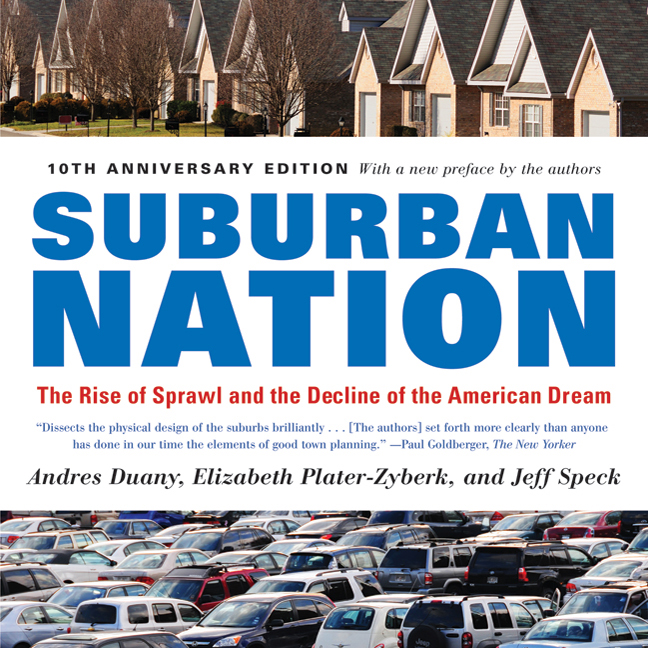
123: Duany, Plater-Zyberk & Speck's Suburban Nation

Despite its title, Suburban Nation: The Rise of Sprawl and the Decline of the American Dream, this book is only partially about suburbia; it also serves as a programmatic statement and justification for New Urbanist development.  Andres Duany, Elizabeth Plater-Zyberk and Jeff Speck are architectural and city planners who designed the planned community of Seaside, Florida, and throughout Suburban Nation they argue that suburban sprawl is not bad because it is ugly.  Rather, the authors (and their urban and suburban informants) argue that because there is a "causal relationship between the character of the physical environment and the social health of families and the community at large, suburbia is bad because it doesn't function to foster community and democracy.  By contrast, communities modeled after "traditional American neighborhoods" can be aesthetically pleasing, make more efficient use of space, and cater to the needs of both individuals and the community.