Showing posts with label vernacular. Show all posts

Friday, April 12, 2013

160: Reyner Banham's Well-Tempered Environment

In The Architecture of the Well-Tempered Environment, Reyner Banham argues that architecture is not just about beautiful building facades - it's also about the mechanical systems that make those buildings function.  Frustrated by the lack of attention paid to mechanical systems by architectural histories (in the late 1960s, when Banham was writing, there were apparently none), Banham pored through trade catalogues, lectures to professional societies, specialist periodicals, building plans and patent-office records, and other primary sources in pursuit not of firsts, but of mosts - of the point at which most buildings had incorporated a new technology and thus the point at which that technology had begun to shape architectural design.  His descriptions of particular buildings are thus discussions of the "typical" rather than the iconic.  With this approach, he takes architecture out of art and subsumes it into a larger category of "environmental management," an interdisciplinary, problem-based profession that treats architecture as context-dependent technological systems or "habitable volumes."

Wednesday, April 10, 2013

146: John Kouwenhoven's Made in America

In Made in America: The Arts in Modern Civilization, John Kouwenhoven links an emergent American aesthetic to our unique status as a "technological civilization," the "only major world power to have taken form as a cultural unit in the period when technological civilization was spreading throughout the world."  Enterprising Americans have shaped this aesthetic by combining vernacular culture, derived from the democratic people, technology, and the American wilderness, with high culture brought back from Europe by elites; when vernacular and high culture compete, the vernacular usually wins.  And as far as Kouwenhoven can tell, that vernacular considers beauty to take the form of useful objects.

To get at this technology-based American vernacular culture, Kouwenhoven reads a wide variety of American authors, including John Hersey, Jonathan Edwards, Poe, Whitman, Horatio Greenough, Harriet Monroe, Melville, Twain, Anderson, Dos Passos,Hunter, and Emerson.  Through these writers, he finds American art in long-barrelled frontier rifles used in the American Revolution, the 'hot jazz in stone and steel' of skyscrapers, steel (instead of iron) farming tools, the Colt revolver, the Corliss engine, clipper ships, steamboats, locomotives, and even Whitney's invention of mass production.  He finds American art in fine art, too, like Gershwin's music and Sheeler's paintings, but even these are uniquely American blends of high and low culture.  And American artists for Kouwenhoven are the people who make industrialism run: engineers, mechanics, farmers, carpenters - as well as writers, painters, and musicians.

Although ascribing a uniform aesthetic to any group of people as large as the United States doesn't make much sense, nor does seeking that culture solely in the work of American writers, Kouwenhoven does make some hugely wonderful contributions to the study of technology and culture.  He erases the divide between high and low art and at the same time between commodity production and artistic production, so that the economic base and cultural superstructure - and thus, with a little elision, technology and culture - are one and the same.  And hey, I totally get what he's saying about the Corliss engine.

Tuesday, April 9, 2013

136: Richard Schein's Landscape and Race

With the edited collection Landscape and Race in the United States, Richard Schein aims to get the reader thinking about the relationship between race and the cultural landscape of everyday places; following Toni Morrison, he argues that "all American landscapes can be seen through a lens of race, all American landscapes are racialized.  For Schein and his contributors, cultural landscape is material, visual, and epistemological, and landscape itself is a process: we shape it to reflect our cultural values, and then the cultural "framings" it contains come back to shape culture, so that whether material or symbolic, "cultural landscapes are constitutive of the processes that created them in the first place."  Further, following Cornel West, Schein argues that race is an anti-essential, social, and political construct that "matters" as if it were ontological.  Examining race in the landscape allows us to understand, in Omi & Winant's worlds, "the sociohistorical process by which racial categories are created, inhabited, transformed, and destroyed."  In other words, studying racialized landscapes can help us understand the process of racialization.

130: JB Jackson's Landscape in Sight

Landscape in Sight: Looking at America is a career-spanning collection of Jackson's essays edited by Helen Lefkowitz Horowitz.  From my notes from March 2012:

Horowitz writes in her introduction that Jackson’s two main purposes are to discover the American (cultural) landscape and to compare it with the landscapes of Europe.  She implicitly raises a host of questions that Jackson addresses in his work – is there a distinctly American landscape?  If there is, what makes it distinct, and why is it different?  What does this landscape say about American culture?  I like that she situates his work within the physical landscapes of Europe and America, but I suspect the ideological landscape (not that Jackson would like that use of the term) in which he was writing influenced him at least as much as the physical.  His work in landscapes belies a deep interest in culture and politics, showing him to be just as interested in ideas as he was in his physical surroundings. 

129: Dolores Hayden's The Power of Place

Dolores Hayden's The Power of Place: Urban Landscapes as Public History is a reflection on 8 years of work at her Boston nonprofit The Power of Place, which she started in 1984 to "to situate women’s history and ethnic history in downtown, in public places, through experimental, collaborative projects by historians, designers, and artists."  Written for academics, fellow practitioners, and the general public, The Power of Place shows how collaboratively-produced public art can bring together urban space and urban history in new, generative ways, while also identifying and preserving significant public places from changes in the configurations of capital.  With the increasing interconnectedness of cities and the rise of placelessness, Hayden argues, an urban landscape history that accesses and generates "place memory" is the surest route to recovering both a sense of place and the historical agency/ capacity for social change that comes with it. 

Monday, April 8, 2013

126: Groth & Bressi's Understanding Ordinary Landscapes
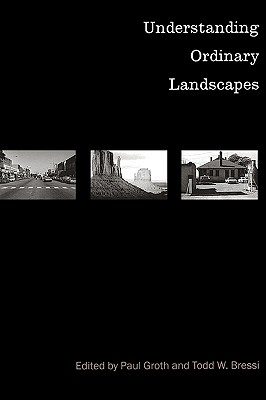
The essays in Paul Groth and Todd Bressi's collection Understanding Ordinary Landscapes are compiled from a two-day symposium at Berkeley in 1990 called "Vision, Culture, and Landscape" that was intended to both celebrate and critique JB Jackson's version of cultural landscape studies.  In general, while the essays underscore Jackson's reliance on and use of visual and spatial information as a way to understand past and present cultures, they grapple with ways to deal with the realities of social and cultural pluralism and their effects on the landscape.  While in many ways Jackson's work was radically subjective and Postmodern before its time, in others it is distinctly Modern, particularly in its emphasis on underlying universals, empirical research, and continuity.

According to Groth, cultural landscape studies defines landscape as the combination of people and place, with an emphasis on the history of how people have used everyday or vernacular space - buildings, rooms, streets, fields, yards - to establish and articulate identities, social relations, and cultural meanings.  When JB Jackson started publishing Landscape in 1951, he also emphasized the activist mission of cultural landscape studies: the more people know about ordinary environments, the more they will become attached to them and the less likely they will be to wantonly destroy them.  Groth and Bressi build on cultural landscape studies via a 6-part framework updated for the 1990s:

  1. focus on ordinary landscapes to get at cultural meaning and environmental experience
  2. shift from a rural emphasis to both rural and urban landscapes, as well as landscapes of production and landscapes of consumption
  3. continue to study diversity and uniformity, but emphasize difference, fragmentation, intertextuality and hybridity instead of a single, unifying narrative
  4. continue to write for the intelligent lay reader
  5. support a broad notion of interdisciplinarity that includes cultural, human, social, critical, landscape architecture, art history and other approaches
  6. engage with visual and spatial information, either in support of or in direct opposition to it; the landscape must remain the primary object of study.  Respect JB Jackson's argument that "landscape... must be regarded first of all in terms of living rather than looking."
This collection includes many heavyweights: David Lowenthal, Peirce Lewis, Dolores Hayden, Wilbur Zelinsky, and more - all folks who are contributing to and thinking about what a new cultural geography might mean and how it might be updated to include social difference and PoMo cultural theory.  It also holds up JB Jackson as the methodological exemplar of cultural landscape studies - which makes sense, because as far as I know, he invented it.