
Showing posts with label community. Show all posts
Showing posts with label community. Show all posts
Tuesday, April 9, 2013
129: Dolores Hayden's The Power of Place

Monday, April 8, 2013
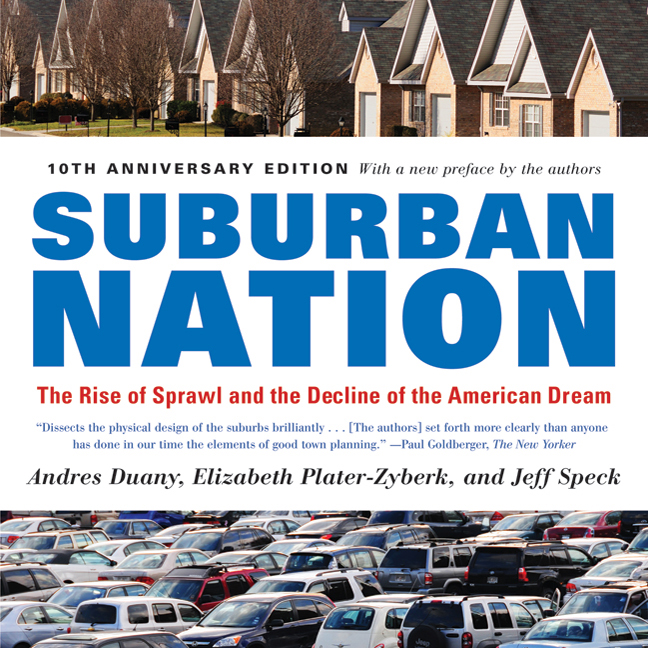
123: Duany, Plater-Zyberk & Speck's Suburban Nation
Wednesday, April 3, 2013
55: Walter Johnson's Soul by Soul

To reconstruct the internal dynamics of the slave market, Johnson studies a wide range of sources, including slaveholders' letters, acts of sale, records of the Louisiana Supreme Court, letters, diaries, business records, and narratives of escaped slaves, all in pursuit of the "experience" of slavery, the market, and the sale. The result is a book structured around the point of sale and the asymmetrical relationships among the three parties involved: the slave, the slave holder, and the trader. All three approached this point using various forms of resistance, manipulation, and negotiation, and all are situated in the pens, offices, and selling blocks of the market.
The crucial thing here is that Johnson clearly portrays the agency and potential for resistance of all three parties, including the slaves, and he reconstructs the worlds of all three, including the spaces - pens, boardinghouses, and plantations - in which they live and encounter one another. Like the new social historians of slavery and labor, Johnson is very much interested in the world as it was lived and perceived by each group; building on their work, he also explores the shifting power relationships and negotiations among them. He concludes that transforming people into property had broad cultural implications for all three groups: planters' perceived superiority lies in their ability to judge and get a good price on the bodies of slaves; slaves balanced the knowledge that they could be sold at any moment with a desire to build community, even in the pens; traders come to see the slaves as the commodities that hold their community together, rather than as people.
And no one liked the space of the market itself (save maybe the traders, who apparently merrily ate their lunches together there) - to the planters, it smacked of grubby commercialism, and to the slaves, it smelled of fear and filth. Although focusing on New Orleans does force Johnson to exclude other markets, it does allow him to drill down into a particular time and place. And the guilt, distaste, fear and brute indifference of that place are harrowing. It's no wonder that it was destroyed soon after the Civil War - but I do think it's important to resurrect it here.
52: Herbert Gutman's The Black Family

Like many other scholars around this time, Gutman was very interested in E.P. Thompson's new social history, which shifted the focus of historical inquiry from relations between groups to relations within them. To access this information, he uses a wide variety of sources, including plantation records, county census schedules, Freedman's Bureau Records, family letters, court testimony, literature, anthropological studies, and oral histories. He also structures the book to follow his own research process, so that the reader follows him back in time from the 20th century to the 1740s, when the plantation system first developed.
In addition to establishing the resiliency of black families, he also established the agentive force within black communities that developed in a space separate from black-white relations. While the possibility that any community can develop autonomously outside the reach of unequal power relations was questioned even as Gutman was writing, as was the separation of politics and culture, Gutman's book still goes a long way toward recovering slave families and bringing them into the historical record.
50: John Blassingame's The Slave Community

Blassingame traces the development of slave culture in American from the slave trade in Africa and the Middle Passage; he argues that slaves retained their culture even as they adapted to new work habits, and he discusses the relationship between slave families, runaways, and resistance to slavery. He also deconstructs the three main stereotypes of slave personality (Sambo, the affectionate, loving servant; Jack, the shifty, lazy good-for-nothing, and Nat, the calculating rapist and murderer) by examining life on different plantations (cotton, sugar, tobacco.)
This book is controversial both because of its sources and its claims. Blassingame relied heavily on slave narratives (supported by plantation records) in order to construct slave communities from the inside, and critics were concerned that many narratives were shaped either by abolitionists with an agenda or by the age of the ex-slaves. I also question his rather dubious claim that slave personalities could still be fitted into universal types.
However, despite these issues, the book was well-received by scholars who were interested in reclaiming the voices of oppressed peoples because it allows the slaves to speak for themselves. It also suggests that slaves were far less passive than previous accounts had assumed, that they had agency and enough autonomy to create their own cultures, and that as a result the relationship between masters and slaves was often closer to a kind of negotiation than an exploitative imbalance of power. Slave culture was thus integral to the culture of antebellum Southern America.
Wednesday, January 23, 2013
24: Laura Pulido's Black, Brown, Yellow and Left
Laura Pulido squeezes several agendas into this book. As an LA activist who worked with an antiracist, anticapitalist group called the Labor/Community Strategy Center to organize a multiethnic left, she is interested in learning from the history and mechanics of previous multi-racial organizing attempts; she is also interested in fostering a class-based leftist politics among her readers. As a scholar, she is fascinated by the sixties and frustrated that histories of radicalism in that period are either mostly white or centered around the Black Panther Party, so she wants to expand the history of racial/ethnic activism to incorporate more of LA's racial and ethnic groups; and she wants to complicate racism by breaking down the black white binary and investigating racial hierarchies and collaborations (or not) in the people she is studying.
 Therefore, Black, Brown, Yellow and Left is part history of the Third World Left, part empirical study of what she calls "differential racism," and part analysis of the growth, development, and decline of a social movement. Pulido accomplishes all of these goals via a comparative analysis of left-leaning activism among three racial/ethnic groups in LA in the late 1960s and early 1970s, using three organizations as stand-ins: the Black Panther Party for African Americans; East Wind, a Japanese American group, for Asian Americans; and CASA, a Chicano/a group, for Latino/as.
Although the details of each case make for good reading, her historical conclusions about the relationship between race/ethnicity, racism, and Left activism reveal the complexities of the Third World Left. Her study of the Black Panther Party suggests that their two main concerns of self-defense and community service were directly related to African American racialization (as the 'Other' to whites, they were at the very bottom of the racial hierarchy and over-policed) and their class position as urban poor. CASA, by contrast, focused on labor organizing and immigration issues reflected Chicano/as position as a 'problem minority': their racial status and particular historical experiences as immigrants and low-wage workers meant that they were a needed part of the economy, but only as subordinated and exploited workers. And as a Japanese American group in a multiethnic, multi-class Asian American community, East Wind focused on issues of identity, community service, and solidarity work; their activities reflected their mixed economic position and their status as a 'middle minority.'
Though Pulido found enough connections among groups to indicate a relatively coherent Third World Left, she quickly discovered that these connections were rather thin. All three organizations were interested in the connection between their own identity as a racial or ethnic 'nation' and anticolonial struggles worldwide, and all three were fighting racism and economic exploitation at home, but they were unsure how to work with other communities in LA. This uncertainty had a lot to do with the complex racial hierarchies in LA at the time: African Americans, for instance, were at the bottom of the social hierarchy, but through the millitancy and visibility of the Black Panther Party they were at the top of the social movement hierarchy. Uncertain positioning, as well as uncertainty regarding the status of one's own group, made lasting coalitions difficult.
Pulido argues that despite a strong need for a multiethnic left today, the situation is much the same as it was in the 1960s and 1970s: strong ethnic groups with weak connections among them, and a weak Third World Left as a result. Despite some issues with scope (using a single organization to stand in for all ethnic/racial organizing, for instance), Pulido's book provides a thoughtful analysis of the intersections between race and class in LA that may well be a useful guidebook for folks trying to build political capital today.
Sunday, January 20, 2013
21: Mitchell Duneier's Sidewalk

Mitchell Duneier is a sociologist who uses what he calls "diagnostic ethnography" to study the lives of poor, black, urban people. In Sidewalk, he focuses on three blocks of Sixth Avenue in Greenwich Village, where a group of magazine and book vendors, scavengers, panhandlers, movers, and assistants form a complex social network that has ties to both the formal and informal economies. Duneier is interested in the moral choices his subjects make within the constraints of larger racial, political, and economic structures, but he is also deeply committed to helped these people get their voices heard; this commitment, and the respect that it entails, is what really makes this book for me.
It took Duneier 7 years to research Sidewalk. He began by making contact with Hakim Hasan, a well-read vendor who specialized in "black books," and Hasan introduced him to other vendors, who in turn connected him with their assistants and eventually with the panhandlers who sometimes work with them to make a little extra money. Three years in, he began working for Marvin, a magazine vendor, during summers, and he also started leaving a tape recorder on at his table all day so that his transcriptions could be faithful to the original conversations. He interviewed a wide variety of people, from influential lawyers and city officials to pedestrians, regular customers, vendors, and relatives of the vendors, and he corroborated vendors' accounts with those of others wherever possible. He also worked with Ovie Carter, a Pulitzer Prize-winning photographer for the Chicago Tribune, to create a photographic record of the blocks, so that photographs and text could inform one another. And whenever he felt he needed to explain a phenomenon in larger structural terms (the self-respect vendors got by bargaining with customers, for instance) he delved into whatever relevant research he could find to help him make connections (in this case, he used research about the relationship between worker satisfaction and self-direction.) This wide variety of methods and sources allow him to reconstruct both the individual people he worked with and the larger structures in which they operate.
His discussion of the "Fuck it!" attitude discussed by many of his subjects is a case in point. After noticing that saying "Fuck it!" seemed to have a pattern to it, especially for the unhoused people he spoke to, he began to ask them what they meant. They told him that people who espoused this attitude often recognized that their addiction to drugs or alcohol played an active role in their becoming unhoused, and they talked about having finally given up trying to maintain their former lifestyle - saying "Fuck it!" For these people, this attitude had several consistent components and was directly related to their homelessness: pervasive application to all areas of their lives; embarrassment or shame, and hope that their loved ones don't see them in their new state; indifference to behavior that the person once saw as necessary or natural, like sleeping in a bed or urinating in a toilet; and the freedom they gained from having let go of their responsibilities to other people. There were also different levels of "Fuck it!" which ranged from ignoring family responsibilities to actively stealing from others. For these people, saying "Fuck it!" was a way of regaining a small amount of control over a life that was rapidly spinning away from them; it was also, in the eyes of the people to whom he spoke, something their community helped them avoid, because it was destructive on both an individual and a social level. Duneier reads into this discussion not a judgment against addiction or homelessness but a strong community that works together to combat depression and excessive drug use, and a support network that works with the few resources it has to keep its members afloat.
Duneier's respect for his subjects is visible in other places as well. He respected the many hours they gave him for interviews, and returned the favor by paying them for their time. He eventually chose to tape record their conversations so that their words wouldn't fall prey to his own recall errors. He asked Hasan, his original contact, to co-teach a seminar with him and secured him a semester-long lecturer position to do so. When he had finished the manuscript, he sat down with every single person he had interviewed, showed them where they were in the book, and made sure his representations were accurate. As a result, he was able to use real names for almost all of his subjects. And, by way of thanks, he returned his publisher's advance and a portion of the book's royalties to 21 prominent figures on the sidewalk.
And, perhaps most respectful of all, he reminds his readers that he cannot speak for his subjects, that he was never quite sure how much of their trust he had earned, and that no one, not even a sociologist, can truly know what is going on inside another person's head. He emphasizes these points to argue that racial, class, and cultural divides are sometimes insurmountable, but, truthfully, I can't think of a better way to level the playing field.
Thursday, January 10, 2013
13: Michael Denning's The Cultural Front
Michael Denning's The Cultural Front, for all its weighty historical detail and analysis, centers around a single theme: that the 1930s amalgamation of labor and cultural interests into a "Popular Front" might be little-known now, but it resulted in a "laboring of culture" that is still reverberating, at least in left-leaning circles, today.
What Denning means by "laboring of culture" is the tricky part, because he sees labor and culture as dialectically related parts, which means that each shapes the other and that they're therefore as difficult to separate as a codependent high school couple. So he spends the first half of the book tracing their conjoined public appearances, including the shared language of the "labor movement," the "proletariat," and the "work," "toil," and "struggle" of labor activists and artists; the "proletarianization" of the culture industries, as children of working-class parents increasingly work as singers, artists, novelists, actors, cartoonists and make mass culture more like working-class culture; and the "social democratic" labor politics that influenced (and was influenced by) everything from textile strikes to fiction to dinner-table conversation.
The result of all this cross-pollination between labor movements, the people in the working-class, and cultural production, Denning argues, was a mass movement to permanently connect American labor with American culture. That way, American culture could represent and be represented by the people, and Leftist and communist social visions could be realized.
And lest his readers think he's making all of this up, Denning spends the whole second half of the book proving it by analyzing products of this labor-culture combo: John Dos Passos' U.S.A, John Steinbeck's Grapes of Wrath, Orson Welles' Citizen Kane, Billie Holiday's love songs, experimental musical theater, gangster films, and something he calls the "ghetto pastoral," of which A Tree Grows in Brooklyn is probably the best-known example. By thoroughly examining each of these cultural productions formally (er, he spends a good 50 pages talking about metaphors and narrative structures in the Dos Passos section alone) and simultaneously situating them in their cultural and historical context, Denning shows that yes, in the 1930s, labor and culture were thoroughly intertwined.
Of course, mass culture is not super communist or particularly pro-Labor today; if anything, the profusion of reality TV shows, re-released remakes of Spiderman movies, auto-tuned pop music, and baby animal YouTube videos that populate mass culture serve more to distract us than to incite us to revolution. But lest this decoupling of labor and culture prove that the Popular Front didn't have as much impact on American culture as Denning claims, he closes his book with this quote from cultural theorist Fredric Jameson:
history progresses by failure rather than by success…. It would be better to think of Lenin or Brecht (to pick a few illustrious names at random) as failures – that is, as actors and agents constrained by their own ideological limits and those of their moment of history – than as triumphant examples and models in some hagiographic or celebratory sense.
In other words, while the movement failed to permanently connect labor and culture, the people in it were both ordinary and extraordinary: they were totally human, but we are still trying to figure out the full implications of the things they produced, the ideas they had, and the politics they espoused. And hey, maybe the most successful movements are those that show us how ordinary humans can create history.
What Denning means by "laboring of culture" is the tricky part, because he sees labor and culture as dialectically related parts, which means that each shapes the other and that they're therefore as difficult to separate as a codependent high school couple. So he spends the first half of the book tracing their conjoined public appearances, including the shared language of the "labor movement," the "proletariat," and the "work," "toil," and "struggle" of labor activists and artists; the "proletarianization" of the culture industries, as children of working-class parents increasingly work as singers, artists, novelists, actors, cartoonists and make mass culture more like working-class culture; and the "social democratic" labor politics that influenced (and was influenced by) everything from textile strikes to fiction to dinner-table conversation.
The result of all this cross-pollination between labor movements, the people in the working-class, and cultural production, Denning argues, was a mass movement to permanently connect American labor with American culture. That way, American culture could represent and be represented by the people, and Leftist and communist social visions could be realized.
And lest his readers think he's making all of this up, Denning spends the whole second half of the book proving it by analyzing products of this labor-culture combo: John Dos Passos' U.S.A, John Steinbeck's Grapes of Wrath, Orson Welles' Citizen Kane, Billie Holiday's love songs, experimental musical theater, gangster films, and something he calls the "ghetto pastoral," of which A Tree Grows in Brooklyn is probably the best-known example. By thoroughly examining each of these cultural productions formally (er, he spends a good 50 pages talking about metaphors and narrative structures in the Dos Passos section alone) and simultaneously situating them in their cultural and historical context, Denning shows that yes, in the 1930s, labor and culture were thoroughly intertwined.
Of course, mass culture is not super communist or particularly pro-Labor today; if anything, the profusion of reality TV shows, re-released remakes of Spiderman movies, auto-tuned pop music, and baby animal YouTube videos that populate mass culture serve more to distract us than to incite us to revolution. But lest this decoupling of labor and culture prove that the Popular Front didn't have as much impact on American culture as Denning claims, he closes his book with this quote from cultural theorist Fredric Jameson:
history progresses by failure rather than by success…. It would be better to think of Lenin or Brecht (to pick a few illustrious names at random) as failures – that is, as actors and agents constrained by their own ideological limits and those of their moment of history – than as triumphant examples and models in some hagiographic or celebratory sense.
In other words, while the movement failed to permanently connect labor and culture, the people in it were both ordinary and extraordinary: they were totally human, but we are still trying to figure out the full implications of the things they produced, the ideas they had, and the politics they espoused. And hey, maybe the most successful movements are those that show us how ordinary humans can create history.
Tuesday, January 8, 2013
10: Claude Fischer's America Calling

America Calling is a social history of the telephone in America from 1900 to 1940, and it's an impressive piece of work. Fischer is a well-funded sociologist - which means that in addition to liking big structural arguments, clearly-defined terms, and general conclusions drawn from massive amounts of data, he also had an army of research assistants to help him with this project. And really, why do just one study when you have enough people to research and write five? Yes, five.
Fischer embarked on this project to answer three questions about the relationship between the telephone and American culture. First, who subscribed to residential telephone service, where did they live, and why did they get phones? Second, how did the collective use of the telephone affect social structure and culture? And third, what personal meanings did phones have for subscribers?
To answer these questions (again, because he had an army of assistants), he undertook the following studies:
- A historical study of how the telephone industry marketed phones to North American households, with particular attention to rural and working-class customers
- A statistical analysis of national diffusion patterns for telephone subscriptions over time to see where in the country people were likely to have phones, and whether phone subscriptions varied with class and rural vs local households
- Community studies in three communities in the San Francisco Bay area (Antioch, Palo Alto, and San Rafael), which included social histories for each town, statistical analyses of phone diffusion, and statistical analyses of social change
- Statistical analyses, also at the community level, of relationships between telephone subscriptions and a variety of indicators, like occupation, presence and number of adult women in the household, and distance from the city center
- Oral histories with 35 elderly people living in the three towns
And the result? After a lot of number crunching, Fischer determined several things, but two of his conclusions regarding social and cultural change particularly stand out (to me). First, rather than functioning primarily as a tool for business or as a replacement for human contact (as promoters intended and detractors feared), the telephone quickly became a "technology of sociability." Americans (especially women) discovered that telephones made organizing events and coordinating people much more efficient - and so they coordinated more events and thus raised their overall level of in-person socializing. Instead of replacing personal interaction, the telephone amplified it and thus contributed to the overall accelerated pace of modern life.
But the telephone wasn't all modern, all the time. Rather than operating as a tool of modernity by destroying local places and helping people connect with strangers in foreign lands (as telephone promoters initially claimed), the telephone was actually anti-modern; it helped people form closer bonds with people they already knew. It thus helped people create a bunch of small, insular, place-bound parochial cultures instead of contributing to the growing mass culture
Both of these conclusions are really fascinating because they show that people used telephones to help them adjust to the upheavals of modernization, and that they were happy to do more things as long as they had the support and close contact of a small group of friends. The strange thing about all of this is that Fischer insists that the telephone didn't change American culture in any significant way (when it obviously did.) I'm hoping he just means that people used it to satisfy existing needs rather than to create new ones.
Saturday, January 5, 2013
5 & 6: Sharon Zukin's Naked City and Landscapes of Power
 I way overslept, and then I had to bring a recalled book back to the library to unfreeze my account, and then I had a craving for lentil soup which necessitated a trip to the grocery store and a couple of hours of paring and blending and reducing - oh, and of course it was raining. It's been a strange day, but the soup was delicious (the recipe is here) and I just finished Landscapes of Power, the second of the two books by Sharon Zukin on my geography list.
Landscapes of Power is the earlier of the two, and in it, Zukin argues that "landscape" is the key cultural product of post-postindustrial capitalism in America. In other words, as we transition from a Modern industrial production economy (and culture) to a Postmodern service and consumption-based economy (and culture), the landscape changes too. According to Zukin, landscapes are always characterized by a tension between abstract market forces, which want to globalize and homogenize everything, and local, place-based communities, who want to stay rooted where they are and not have to pick up and move every time the economy changes and they get laid off. Postmodern landscapes are composed of liminal spaces that blend markets and places - so when you go to a museum, for instance, you could just walk in and look at the paintings, but they would really prefer it if you went to the IMAX, paid for a guided tour, and maybe picked up a few things at the gift shop, too. It's like the long arm of capitalism is penetrating further and further into every aspect of our lives.
 Landscapes of Power is interesting, but Naked City was much more fun to read. In the twenty years between the two books (1991 and 2010), Zukin's style has gotten more conversational; more importantly, though, the internet, reurbanization, the housing bubble, and 9/11 have all made the world a very different place from what it was in 1991, and she takes all of these developments into account. This time, urban spaces are still landscapes of power, and culture and the economy are still based on consumption instead of production. However, her focus now is not on the decline of modern industrial culture but on the rise of the "authentic city," a place characterized by a tension between old, historic, deep-rooted elements and new, creative, truly innovative forces. The book is comprised of six case studies, each a different place in New York city, that examine the meaning of "authentic" and its relationship to power.
I really hate the uncritical use of the word "authentic," so I was pleasantly surprised to find that Zukin spends a good 30 pages theorizing it and that she's well aware that authenticity is socially constructed. The part I particularly like (aside from her liberal use of the word "hipster," hah) is her construction of authenticity as an elitist, consumption-based concept. Claiming to either be or see the authentic gives you a certain amount of power: you're the real deal, or you are worldly enough that you know it when you see it. But authenticity can only be perceived from the outside, by someone who has enough mobility and distance not just to discern between the real and the fakes, but to care about authenticity in the first place. Hence, white gentrifiers moving into a poor black neighborhood might see their new home as an authentically gritty urban place, but the neighborhood's current residents, who are more concerned with getting their bills paid and taking care of themselves and their families, just see it as home. The gentrifiers are consuming the experience of living there, while the current residents are simply inhabiting the place. (I guess there's no particular reason why the black residents wouldn't seek out authentic experiences or places in some other form, but she doesn't go into that - one of the failings of the book.)
Together, Zukin's two books does a lot to spatialize capitalism and inscribe the urban landscape with cultural meaning. Naked City in particular, though, reminds me why I got into this business in the first place.
Wednesday, January 2, 2013
3: Massey & Denton's American Apartheid

2 for 2 today! Huzzah!
As the title suggests, American Apartheid: Segregation and the Making of the Underclass is both sociological (the "underclass") and a bit polemical ("apartheid") about the relationship between black urban poverty and the "American institution" of the black ghetto. Their book is clear, easy to read, and incredibly strident in its arguments. They're also well-supported by the National Institute of Child Health and Human Development, a Guggenheim grant, a Faculty Development Award, and the National Opinion Research Center, which means that they had enough money to hire plenty of researchers and analysts. And it shows: the depth of research in this thing is impressive.
The authors' argument is pretty straightforward: more than any other factor, race-based residential segregation creates the "urban underclass," a segment of the urban population so socially and spatially isolated from the labor market that they seem to have no chance of climbing out of poverty. The primary instrument of segregation is the urban ghetto, and the residents are almost exclusively black.
Urban ghettos have been fascinating to me ever since I biked through them in Chicago in the early 2000s - I couldn't figure out why anyone would live in an intensely poor, dilapidated neighborhood when a much nicer one was sometimes just a few blocks away. The two books that provided the strongest answers for me back then were Alex Kotlowitz' There Are No Children Here and William Julius Wilson's When Work Disappears; the first provides an intensely human look at growing up in a Chicago housing project, and the second provides clear, well-supported structural explanations for the development and persistence of the ghetto.
American Apartheid basically builds on Wilson's argument. Wilson argues that shifts in the economy contributed to urban economic decline and the creation of new jobless ghettos. Discriminatory housing practices combined with discriminatory hiring practices concentrated black urban residents into poor, predominantly black neighborhoods, so when shifts in the economy (like automation in the auto industry, for instance) threw blacks out of work, whole neighborhoods went under. Shops closed, community institutions left, and the ghettos became so thoroughly separated from the rest of society that they formed their own norms, expectations, and speech patterns.Seeing this decline, those families that could leave, did, which left the poorest residents marooned in inner city slums without employment prospects or transportation to jobs in the suburbs or other parts of the city.
Massey & Denton add to this line of logic an emphasis on residential segregation. If these same black people were living in integrated neighborhoods, the authors argue, their white and ethnic neighbors would probably still have jobs in an economic downturn, so their neighborhood institutions, shops, etc would be able to stay open, the neighborhoods would remain relatively stable and connected to the workforce, and those thrown out of work would eventually be able to find jobs again. However, even in the late 1980s (when they were writing), most white people did not want black people in their neighborhoods, violence and intimidation was still rampant, and the Fair Housing Act was still really hard to enforce. Thus, segregation was the key contributing factor to black isolation and poverty. And since the authors see residential integration as the first step toward social integration, their solutions to these problems are stronger, more systematic enforcement of the Fair Housing Act and active dismantling of urban ghettos.
Since this book was written, several major changes have taken place: in an effort to break down the ghetto, cities like Chicago have replaced their massive (and massively deteriorated) public housing projects with mixed-income housing and city-wide HUD vouchers; the rise of a creative class sensibility has brought white middle class people to the ghetto in search of authenticity and cheap rent; and gentrification processes have massively transformed inner city neighborhoods in a kind of forced resegregation (from black to white.)
Given these processes, does the residential segregation aspect of the urban ghetto still stand? Or, more bluntly: have these processes of desegregation/ resegregation done anything positive for the plight of the urban poor?
2: James Shortridge's The Middle West
Shortridge is a geographer with a fascination for cultural history, and the whole point of this book is to figure out where, exactly, the Midwest is, and what it means in American culture. The basic argument is that the Midwest and the popular
conception of it have changed over time, but that the Midwest -
particularly in its rural, yeoman farmer incarnation - is inextricably
linked to American identity as a whole, so changes in the Midwest
reflect changes in American culture more generally. It's not exactly the most controversial of books (unless, I guess, you live in Michigan and have strong ties to your identity as a Midwesterner?) but it does use a pretty innovative combination of sources and methods. Also, I don't know what the average computer was capable of in the late 1970s/ early 1980s, but he does an impressive amount of data crunching from handwritten sources and generates some cool maps as a result.
While he does do some surprisingly interesting stuff with old magazines, journals, and novels, the parts I like most about this book (surprise, surprise) are the maps.
One of the things he argues is that the image of the Midwest as a rural, prosperous, agricultural place has been so important in American culture that the physical location of the Midwest in the popular imagination has migrated as a result. The cool thing is that he has the data to prove it.
Here, he reproduces a map created by a gentlemen who, in 1958, asked 450 postmasters whether their community was in the Midwest or not.

Sorry for my crappy Hipstamatic photography, but the black dots in the shaded region are postmasters who said they were in the Midwest, and the open circles are postmasters who said they were not in the Midwest. In 1958, the epicenter of the Midwest was in Chicago, and the Midwest itself mostly still covered the traditional 12 Midwestern states: Minnesota, the Dakotas, Nebraska, Kansas, Michigan, Missouri, Iowa, Ohio, Wisconsin, Indiana, and Illinois. Also, he doesn't talk about this, but the postmasters look like they're along rail (or maybe water?) lines radiating out from Chicago, which might have something to do with the configuration of the region both physically and in their imaginations.
Fast forward to 1980. Shortridge is ok with using pop lit to gauge past attitudes, but I think he thinks that where the present is concerned, there's no sense in mucking around with cultural productions when you can just ask people what they think. So he does. In 1980, he has friends in 32 states survey more than 2,000 undergrads on their opinions of the Midwest. He asks his respondents to do two things: first, to write down all the traits they consider to be quintessentially Midwestern; and second, to circle the Midwest on a map.
In response to the first question, students from both inside and outside the traditional 12 Midwestern states all write pretty much the same thing: Midwesterners are hardy, honest, friendly, hardworking farmers who live in flat places with cold winters and hot summers. In response to the second, they draw a wide variety of maps, but when he puts all of their responses together, the composite map looks like this:

Apparently, sometime between 1958 and 1980, the Midwest migrated down from the heavily industrialized Great Lakes to one of the last bastions of prosperous agriculture in the states - Kansas and Nebraska. Shortridge theorizes that this movement shows just how badly Americans need the Midwest to be a rural heartland - rather than update our popular conception of the pastoral Midwest to include the industrialization in, say, Chicago and Detroit, we would rather just move it down to rural Kansas and pretend Chicago and Detroit don't exist.
This is all very strange, and very contingent on Americans being a coherent unit undivided by pesky things like race, gender, and class. It does, however, have a certain resonance with Michael Pollen's "supermarket pastoral," and with the nostalgia embedded in things like the current farm-to-market movement. Who knows - maybe American culture, or at least part of it, does still need to believe we come from a nation of yeoman farmers.
While he does do some surprisingly interesting stuff with old magazines, journals, and novels, the parts I like most about this book (surprise, surprise) are the maps.
One of the things he argues is that the image of the Midwest as a rural, prosperous, agricultural place has been so important in American culture that the physical location of the Midwest in the popular imagination has migrated as a result. The cool thing is that he has the data to prove it.
Here, he reproduces a map created by a gentlemen who, in 1958, asked 450 postmasters whether their community was in the Midwest or not.

Sorry for my crappy Hipstamatic photography, but the black dots in the shaded region are postmasters who said they were in the Midwest, and the open circles are postmasters who said they were not in the Midwest. In 1958, the epicenter of the Midwest was in Chicago, and the Midwest itself mostly still covered the traditional 12 Midwestern states: Minnesota, the Dakotas, Nebraska, Kansas, Michigan, Missouri, Iowa, Ohio, Wisconsin, Indiana, and Illinois. Also, he doesn't talk about this, but the postmasters look like they're along rail (or maybe water?) lines radiating out from Chicago, which might have something to do with the configuration of the region both physically and in their imaginations.
Fast forward to 1980. Shortridge is ok with using pop lit to gauge past attitudes, but I think he thinks that where the present is concerned, there's no sense in mucking around with cultural productions when you can just ask people what they think. So he does. In 1980, he has friends in 32 states survey more than 2,000 undergrads on their opinions of the Midwest. He asks his respondents to do two things: first, to write down all the traits they consider to be quintessentially Midwestern; and second, to circle the Midwest on a map.
In response to the first question, students from both inside and outside the traditional 12 Midwestern states all write pretty much the same thing: Midwesterners are hardy, honest, friendly, hardworking farmers who live in flat places with cold winters and hot summers. In response to the second, they draw a wide variety of maps, but when he puts all of their responses together, the composite map looks like this:

Apparently, sometime between 1958 and 1980, the Midwest migrated down from the heavily industrialized Great Lakes to one of the last bastions of prosperous agriculture in the states - Kansas and Nebraska. Shortridge theorizes that this movement shows just how badly Americans need the Midwest to be a rural heartland - rather than update our popular conception of the pastoral Midwest to include the industrialization in, say, Chicago and Detroit, we would rather just move it down to rural Kansas and pretend Chicago and Detroit don't exist.
This is all very strange, and very contingent on Americans being a coherent unit undivided by pesky things like race, gender, and class. It does, however, have a certain resonance with Michael Pollen's "supermarket pastoral," and with the nostalgia embedded in things like the current farm-to-market movement. Who knows - maybe American culture, or at least part of it, does still need to believe we come from a nation of yeoman farmers.
Friday, December 28, 2012
post-ac
I have spent several hours now reading about the jobs situation for Humanities PhDs - yes, partly to keep from reading the book on Long and the Great Depression that I cracked open yesterday, but also because I've been suspecting lately that something fishy is going on with my post-grad-school employment opportunities. And if there are really no jobs, then surely there's a better use of my time than preparing for jobs that don't exist.
Plenty of other people have written eloquently on the actual numbers, so I'm not going to wander much into quantitative analysis, and anyway, my stats are kinda rusty. But let me say that even my (extremely) cursory research has me relieved: it looks like somewhere between a quarter and a third of history PhDs are still finding tenure-track jobs, and yes, there are many, many people adjuncting, but there are also people in government, the military, non-profits, the tech sector - lots of things that put research, writing, and teaching skills to good use. (This article from The Chronicle is probably the most hopeful thing I've read in a while, and it has charts!) In other words, considering that my background is in retail and trucking, grad school really is pretty likely to help me change careers.
Since I would rather like to buy a house in the next ten years, I've also been poking around in salary and cost of living information. The Chronicle has a lovely interactive piece on faculty salaries for more than 1200 universities, the Bureau of Labor Statistics lists wage data by county for a ton of occupations, and Zillow.com provides approximate housing cost data for everywhere I've ever searched (so, er, major cities in the US, anyway.) As a rule of thumb, I like to keep fixed costs (rent, bills, phone) to one two-week paycheck... and so after a little crunching for some of the occupations in the Chronicle article, I think that (in Austin, anyway) most of these professions would put me in house-buying territory within the decade.
So far, so good. As long as I play my cards right, getting a PhD in the humanities is not a bad idea at all - it's actually a pretty good way to get an interesting job and haul my ass up into the middle class.
Playing my cards right, though, is the part that's still a bit baffling, because I don't quite understand what's going on here. As I read through a few "post-ac" blogs and gloom-and-doom employment predictions, a few patterns stand out: people who are staking their whole identity on getting a tenure-track job, people who are afraid to talk about non-academic career paths lest they be shunned or kicked out of their programs, people who feel cheated by the system when they don't get their dream job at a prestigious university, people who need support groups to help them down from the ivory tower. Maybe I'll feel this way in a few years, but right now, these people read like the lost souls in Barbara Ehrenreich's Bait and Switch, stuck in some kind of unemployment purgatory. Or, perhaps more aptly, like disgraced and brainwashed members of a secret cult. And for the record, I've been the latter, and good lord I don't want to go back.
I hope there is room in this system for people who just want normal things like job security, an interesting career, and enough money to make a comfortable living. And I hope these disgruntled folks are the exception rather than the rule, because I, for one, would like to think this whole shindig is about opening options up, not closing them off.
Plenty of other people have written eloquently on the actual numbers, so I'm not going to wander much into quantitative analysis, and anyway, my stats are kinda rusty. But let me say that even my (extremely) cursory research has me relieved: it looks like somewhere between a quarter and a third of history PhDs are still finding tenure-track jobs, and yes, there are many, many people adjuncting, but there are also people in government, the military, non-profits, the tech sector - lots of things that put research, writing, and teaching skills to good use. (This article from The Chronicle is probably the most hopeful thing I've read in a while, and it has charts!) In other words, considering that my background is in retail and trucking, grad school really is pretty likely to help me change careers.
Since I would rather like to buy a house in the next ten years, I've also been poking around in salary and cost of living information. The Chronicle has a lovely interactive piece on faculty salaries for more than 1200 universities, the Bureau of Labor Statistics lists wage data by county for a ton of occupations, and Zillow.com provides approximate housing cost data for everywhere I've ever searched (so, er, major cities in the US, anyway.) As a rule of thumb, I like to keep fixed costs (rent, bills, phone) to one two-week paycheck... and so after a little crunching for some of the occupations in the Chronicle article, I think that (in Austin, anyway) most of these professions would put me in house-buying territory within the decade.
So far, so good. As long as I play my cards right, getting a PhD in the humanities is not a bad idea at all - it's actually a pretty good way to get an interesting job and haul my ass up into the middle class.
Playing my cards right, though, is the part that's still a bit baffling, because I don't quite understand what's going on here. As I read through a few "post-ac" blogs and gloom-and-doom employment predictions, a few patterns stand out: people who are staking their whole identity on getting a tenure-track job, people who are afraid to talk about non-academic career paths lest they be shunned or kicked out of their programs, people who feel cheated by the system when they don't get their dream job at a prestigious university, people who need support groups to help them down from the ivory tower. Maybe I'll feel this way in a few years, but right now, these people read like the lost souls in Barbara Ehrenreich's Bait and Switch, stuck in some kind of unemployment purgatory. Or, perhaps more aptly, like disgraced and brainwashed members of a secret cult. And for the record, I've been the latter, and good lord I don't want to go back.
I hope there is room in this system for people who just want normal things like job security, an interesting career, and enough money to make a comfortable living. And I hope these disgruntled folks are the exception rather than the rule, because I, for one, would like to think this whole shindig is about opening options up, not closing them off.
Thursday, December 27, 2012
vacation/procrastination (so would that be... procrastication?)
School has been out for almost two weeks, and I haven't read a thing. I mean - I have a book open in front of me, and I intend to read all about Huey Long and the Great Depression tonight, but I have more pressing things to do first, as I have for the past couple of weeks. Right after I turned in my last grades and responded to the last student email, I did many of the little nagging things I haven't been able to do all semester: I cleaned my house, shuffled around the furniture, took a load to Buffalo Exchange. That done, I baked some cookies and watched a little TV; during the next few days I went for runs, and I dared to sleep in and lounge around until noon. I went dancing multiple days in one week and saw people enough to remember their names and ask them about things we had talked about just a few days earlier. I went to work often enough that the same thing happened - and for a moment I remembered the thing I really loved about retail and my world before school: the closeness and amiability, and the repetition and teamwork and fascination with the everyday that fostered it.
Sometime that week I had a drink - ok, three - reasoning that even if I did wake up with a hangover, I didn't have to do much thinking the next day. The boy and I went out to our old late-night haunt and had greasy food and joked around with the late-night servers. We slept in.
And then, finally, the luxury of having time to do laundry and take three hours to pack for a week back home in the motherland, where getting to know my niece and nephew and cooking my sister- and brother-in-law a couple of home-cooked meals trumps reading about long-ago events, hands down. Tonight, we had roast chicken and cheesy polenta; tomorrow I'm simmering chicken soup from scratch, since everyone has the flu or is recovering from it. And when they're asleep (they crash out early), I get to tinker with Photoshop and watch movies and read a novel and finally - finally! - decompress enough to start thinking about what I want to do when I grow up and whether the path I'm on will get me to where I want to be.
I wrote a little while ago about how in school, we need to protect our free time for the unpaid work that will get us out of here; after two weeks of break, I'm remembering just how protective I was of my free time before I came back to school. I read novels; I learned about baking breads and cookies and cakes; I studied knitting techniques and designed and knitted sweaters with increasingly elaborate lacework. I watched a lot of film noir, and spent whole afternoons wandering in and out of junk shops and bookstores. I went on ridiculously long bike rides. I had time and energy to really be with my friends when I was with them - and I had a lot of time to be with them. I think if I had that much time again I would spend more time writing and more time volunteering, but otherwise these are things I miss - connecting with people and learning how to do things and just generally absorbing the world we live in.
My concern now is that academia, if I stay in it, won't afford me the work-life balance that allows me to be a real person, with varied interests and a strong attachment to the real world. It hasn't yet, and after almost four years, I'm beginning to worry that it won't. Hence the procrastination.
Sometime that week I had a drink - ok, three - reasoning that even if I did wake up with a hangover, I didn't have to do much thinking the next day. The boy and I went out to our old late-night haunt and had greasy food and joked around with the late-night servers. We slept in.
And then, finally, the luxury of having time to do laundry and take three hours to pack for a week back home in the motherland, where getting to know my niece and nephew and cooking my sister- and brother-in-law a couple of home-cooked meals trumps reading about long-ago events, hands down. Tonight, we had roast chicken and cheesy polenta; tomorrow I'm simmering chicken soup from scratch, since everyone has the flu or is recovering from it. And when they're asleep (they crash out early), I get to tinker with Photoshop and watch movies and read a novel and finally - finally! - decompress enough to start thinking about what I want to do when I grow up and whether the path I'm on will get me to where I want to be.
I wrote a little while ago about how in school, we need to protect our free time for the unpaid work that will get us out of here; after two weeks of break, I'm remembering just how protective I was of my free time before I came back to school. I read novels; I learned about baking breads and cookies and cakes; I studied knitting techniques and designed and knitted sweaters with increasingly elaborate lacework. I watched a lot of film noir, and spent whole afternoons wandering in and out of junk shops and bookstores. I went on ridiculously long bike rides. I had time and energy to really be with my friends when I was with them - and I had a lot of time to be with them. I think if I had that much time again I would spend more time writing and more time volunteering, but otherwise these are things I miss - connecting with people and learning how to do things and just generally absorbing the world we live in.
My concern now is that academia, if I stay in it, won't afford me the work-life balance that allows me to be a real person, with varied interests and a strong attachment to the real world. It hasn't yet, and after almost four years, I'm beginning to worry that it won't. Hence the procrastination.
Thursday, June 14, 2012
Lewis Mumford - The City in History

Mumford is such a lovely writer, and it's easy to think that what he lacks in primary research he more than makes up for in thought-provoking speculation. He's a utopian thinker who advocates a balance between humans and their environment in the form of decentered, thoughtful, federated social structures. He also writes a lot about the relationship between space and technology. This book is a ginormous grand narrative of "the city" in Western civilization, from the very dawn of time to the present, so here are just a few of my notes:
In an era shaped by white flight, deindustrialization/ suburbanization, not to mention the fear of nuclear war, Mumford calls for a return to city building instead of
destruction. He argues that cities serve two main purposes: religion and the
state. Biology is a (distant?) third,
though really cities are for the people, so people should come first. The shrine and the citadel are its two dominant structures, carried over
from villages. The city exists to
nurture human biological and cultural reproduction, not to use technology to
tame whole populations into submission. The city is the stand-in for society, and he is very adamant that spatial forms and social forms
interconnect. Also, space and the built environment are articulated with technology;
humans shouldn’t be afraid of their own inventions or let a few wackos use
technology to control them. The city
should be humanity, magnified; communality, nurturing, love. I sense Hardt & Negri here, where a
surplus of love and community lead to a radical democracy, and also the dread fear of totalitarianism and
technology, which apparently went hand-in-hand in WWII, what with the Nazis and
all.
Saturday, March 24, 2012
Expressways dismembered poor neighborhoods, destroying local communities; they also enabled both the dispossessed (and the wealthy who had also fled) to return to work in the inner city - to sustain, and to bleed it, respectively.
Lucy Lippard, The Lure of the Local: Senses of Place in a Multicentered Society, New York: The New Press, 1997, p 202.
Lucy Lippard, The Lure of the Local: Senses of Place in a Multicentered Society, New York: The New Press, 1997, p 202.
Tuesday, February 14, 2012
The vagabond's wayward travels meant that he always had traces of elsewhere about him which disturbed those who had chosen a settled and rooted existence - the vagabond threatened to undo the comforts of place and transgressed the expectations of a sedentarist metaphysics.
Tim Cresswell, Place: A Short Introduction. Malden, MA: Blackwell Publishing, 2004.
Tim Cresswell, Place: A Short Introduction. Malden, MA: Blackwell Publishing, 2004.
Thursday, September 29, 2011
low income communities and communities of color are not the same thing
The relationship between low income communities, communities of color,
and biking seems to be getting more press lately as communities from
Portland to Detroit to Milwaukee work to incorporate bicycling into
their transportation infrastructure and their transportation culture.
Below, Keith Holt of Milwaukee Bicycle Works talks about how bike shops
and community cycling organizations can help people in poor
neighborhoods get access to bikes and keep them rolling. What's even
more interesting to me is his discussion of biking as simultaneously a
poor man's thing and a rich white man's thing, something somehow beyond the boundaries of mainstream cultural acceptance. (via Greater Greater Washington)
Subscribe to:
Comments (Atom)