In Steamboats on the Western Rivers: An Economic and Technological History, Louis Hunter situates a detailed history of the development of steamboat technology in the social, technological, and economic context in which it developed; he argues that "the growth of the West and the rise of steamboat transportation were inseparable; they were geared together and each was dependent upon the other."
Using contemporary newspapers, census documents, traveller accounts, and other primary sources form about the 1780s to the end of the 19th century, Hunter shows that steam transportation technology was the result of many people's contributions (both English and American), not just those of a few great men. He also shows that in America, steam navigation started on the Atlantic seaboard but quickly moved inland to the Western rivers, where steamboats dominated inland transportation and commerce for a generation; and he argues that from 1925 to 1850 the steamboat was the main technological agent in developing the Mississippi basin from a "raw frontier society" to "economic and social maturity." Finally, he claims that the Western steamboat was known worldwide as the "typical" American steamboat partly because it was so important to the economy of the region and partly because it was unique in its design, construction, and operation. Published in 1949, this book was the scholarly survey of the development of steam navigation on the Western rivers that pulled together technology, operations, and governmental intervention into a consistent whole.
Showing posts with label capitalism. Show all posts
Friday, April 12, 2013
162: James Flink's The Automobile Age
In James Flink's The Automobile Age, the automobile, and its attendant complex of technologies, mass-production techniques, industrial development, roads, economic and public policy, and changes in American "lifeways" resulting from "mass personal automobility," are central to the history of capitalist development in general and to American history in particular. Flink's materialist approach combined with the scope of this book - he attempts to cover the rise and fall of the Automobile Age in its social, technological, business, and global contexts, from the turn of the last century to the early 1970s - make it both a fascinating history of automobility and an argument for human agency even in what looks like global domination by the car.
Flink's narrative covers many of the canonical topics within industrialization and automobility: the Fordist system of mass production/ mass consumption; transformations in social relations and the landscape as a result of automobility; Sloanism, bureaucracy, and flexible, style-based mass production; global automobility coupled with competition from Europe and Japan; and social and environmental critiques of automobility combined with the "world car." He discusses these processes by carefully tracing technological diffusion within the technological system of the automobile.
Thursday, April 11, 2013
157: Susan Strasser's Never Done
In Never Done: A History of American Housework, Susan Strasser argues that housework, the job done by more people in America than any other, "cannot be separated from the broader social and economic history of the United States." The women who did housework supported the men who built factories and cities, and the manufactured products and urban culture produced in those factories and cities in turn shaped women's housework. Strasser thus brings 19th century housewives into history AND provides an exhaustive history of household technologies.
Strasser is interested in what 19th century housewives actually did and what technologies they really used, not in the history of the technologies per se; the date that most households seemed to have a particular kind of technology and how most housewives seemed to use it are a lot more important to her than the date the technology was patented or the technological innovations that went into it or when the first privileged few got ahold of it. Therefore, she uses new social history methodologies to access her subject. Her sources include reformers' reports on intolerable living conditions, government documents on standards of living, sociologists' descriptions of daily life, manufacturers' market research, ads, catalogues, travel accounts, letters, and advice manuals, cookbooks, and women's magazines. In all of these sources, she's looking not so much at the opinions or prescriptive advice but at the ways in which particular technologies and practices are framed - as new, old-fashioned, commonplace, etc. This strategy allows her to approximate what American housewives' lives might have been like at different points in time form 1850 to 1930.
154: Donald Worster's Rivers of Empire
Donald Worster's Rivers of Empire: Water, Aridity, and the Growth of the American West is a history of the development of the American West through the lens of water management technology. Building on substantial archival research, Worster argues that
The West, more than any other American region, was built by state power, state expertise, state technology, and state bureaucracy. That is another way of saying that it has been, and is, the most thoroughly modern of American regions, and therefore that its experience, particularly in the matter of water, has been most instructive for deciphering the confused messages of that modernity.
By positioning water as technology rather than nature and the West as a federally-funded, man-made landscape, Worster both deconstructs the West's self-image as independent and free of government control AND reconstructs the region not as a colony of the East but as the seat of a global American empire.
The West, more than any other American region, was built by state power, state expertise, state technology, and state bureaucracy. That is another way of saying that it has been, and is, the most thoroughly modern of American regions, and therefore that its experience, particularly in the matter of water, has been most instructive for deciphering the confused messages of that modernity.
By positioning water as technology rather than nature and the West as a federally-funded, man-made landscape, Worster both deconstructs the West's self-image as independent and free of government control AND reconstructs the region not as a colony of the East but as the seat of a global American empire.
150: David Nye's American Technological Sublime
In American Technological Sublime, David Nye investigates the history of the social construction of the sublime in America from about 1820 to the early 1990s. Nye's American sublime is somewhat like 18th century European concepts of the sublime, which involve human apprehension of something so big, beautiful, and incomprehensible that the mind is seized with terror, awe, and pleasure all at once; these extremes dominate the human mind, so that the person transcends the material world and comes into contact with the divine. However, while the European sublime was a category of experience accessible only to educated individuals in contact with nature or sacred architecture, the American sublime has distinctly populist, nationalist, and capitalist overtones. As early as the 1830s, American travellers in the West were reporting on the sublimity of the natural landscape, while people in the presence of massive new technologies were experiencing a transcendence usually reserved for nature or high art, and revivalists were recommending sublime tourist sites like Niagara as places to get in touch with the divine. The American sublime was thus a popular, communal experience rather than an elite individual one; it was associated with emotions of awe, pleasure and terror rather than worldly transcendence; it could involve feats of engineering as well as high art and natural beauty; and its ties to American technological transformations of the landscape meant that the experience could be incorporated into nationalist narratives (love of country) and commodified into landscapes of fantasy and pleasure (Disneyland). As Nye argues, the American sublime is key to American cultural identity.
Although the chapters are roughly chronological, Nye is more interested in talking about sublimeS rather than THE sublime, so that differences of time, place, and personal experience only add to his discussion. Technological sublimes include the railroad as a "dynamic sublime" that awed in its ability to unite, expand, and enrich the nation; bridges and skyscrapers as a "geometric sublime" that "appeared to dominate nature through elegant design and sheer bulk.... the triumph of reason in concrete form;" factories, electric power plants, and other manufactories as a new "mechanical sublime, which regulates the mind and technologically supersedes nature;" the electrified urban landscape as an accidental "electrical sublime" that dominated night, embodied the values of capitalism and "transformed the appearance of the world;" the atomic bomb as a new, more terrifying form of the dynamic sublime, and Vegas and Disneyland (with nods to Niagara and the Grand Canyon) as the "consumer sublime," commodified pleasure landscapes that provide the rush associated with dislocation from the world of work in simulation of the sublime.
Throughout, Nye traces the ways in which increased articulations between the sublime and mass American culture have led to a watering down of what was once a transcendent, otherworldly dislocation from reality, even as they make that experience accessible to more people. While he argues that the sublime is at once an individual and collective experience, he also shows how top-down and structurally conditioned that experience has been.
Although the chapters are roughly chronological, Nye is more interested in talking about sublimeS rather than THE sublime, so that differences of time, place, and personal experience only add to his discussion. Technological sublimes include the railroad as a "dynamic sublime" that awed in its ability to unite, expand, and enrich the nation; bridges and skyscrapers as a "geometric sublime" that "appeared to dominate nature through elegant design and sheer bulk.... the triumph of reason in concrete form;" factories, electric power plants, and other manufactories as a new "mechanical sublime, which regulates the mind and technologically supersedes nature;" the electrified urban landscape as an accidental "electrical sublime" that dominated night, embodied the values of capitalism and "transformed the appearance of the world;" the atomic bomb as a new, more terrifying form of the dynamic sublime, and Vegas and Disneyland (with nods to Niagara and the Grand Canyon) as the "consumer sublime," commodified pleasure landscapes that provide the rush associated with dislocation from the world of work in simulation of the sublime.
Throughout, Nye traces the ways in which increased articulations between the sublime and mass American culture have led to a watering down of what was once a transcendent, otherworldly dislocation from reality, even as they make that experience accessible to more people. While he argues that the sublime is at once an individual and collective experience, he also shows how top-down and structurally conditioned that experience has been.
Wednesday, April 10, 2013
145: John Kasson's Civilizing the Machine
The five essays that make up John Kasson's Civilizing the Machine: Technology and Republican Values in America, 1776-1900 all examine different aspects of the relationship between technology and Republican ideology. Using a wide variety of primary sources, including speeches, newspaper accounts, sketches, and writers like Emerson, Bellamy, Thomas Jefferson and Tenche Cox, Kasson shows that Americans first rejected technological development because they feared becoming corrupt like Europe; then incorporated Republican ideology into industrialization to stave off that same corruption by lending moral purity, industry, and restraint to technological development; and then found themselves being exploited by the very technologies they hoped to control, all in the name of Republicanism. Kasson thus uses the relationship between political ideology and industrialization in the 19th century to complicate the relationship between technology and culture.
141: Lewis Mumford's Technics and Civilization
Lewis Mumford's Technics and Civilization (1934) is a massive history of technological development in the Western world in three phases: the Eotechnic, from AD 1000 to the 18th century, which was characterized by diverse, unsystematized inventions and ideas; the Paleotechnic, from the late 18th century to the late 19th, which was "reckless to the point of barbarism" in its war, death, brute strength, and industrialization; and the Neotechnic, which began in the early 20th century and is hopeful that new alloys, electricity, communication technologies will lead to better, more organic social and technological projects. Throughout, Mumford argues that "No matter how completely technics relies upon
the objective procedures of the sciences, it does not form an independent
system, like the universe: it exists as an element in human culture and it
promises well or ill as the social groups that exploit it promise well or ill." He advocates a more egalitarian technopolitics via an increased understanding and assimilation of the machine.
138: Langdon Winner's Autonomous Technology
Published in 1977, Langdon Winner's Autonomous Technology: Technics-out-of-control as a Theme in Political Thought examines the idea of autonomous technology as a "convenient receptacle for a host of contemporary anxieties." Using literary and political writings from a wide range of historical moments, he shows how autonomous technology has been associated with fears about a loss of human agency and self-governance, both at the individual and the societal level, to machines of our own creation. Technology therefore has a politics, and if humans are to regain control and autonomy, we need to dismantle technologies, learn how they work, and rebuild them so that they serve human needs rather than their own dominance and reproduction.
Winner argues that while technology has been central to political thought for some 200 years, the 20th century proliferation of technologies and their integration in everyday life has made technology into a "vast, diverse, ubiquitous totality that stands at the center of our modern culture." This diversity makes the word "technology" so complex as to be meaningless, or at least illegible, with the result that technology itself becomes a rather terrifying black box, appearing to usurp political power and move forward of its own volition. In modernity, the complexity of technology requires a new ruling class, engineers, to interface with it, and an environment conducive to its operations, with which architects and engineers happily comply. Technology also requires a particular social order to fulfill its operational requirements - which is to say that technology creates a particular form of technological politics, where the claim that "man controls technology" looks more irrational than the opposite.
Tuesday, April 9, 2013
132: Don Mitchell's The Lie of the Land
In The Lie of the Land: Migrant Workers and the California Landscape, Don Mitchell uses labor history, critical social theory, and cultural landscape studies to reveal the "connection between the material production of landscape and the production of landscape representations, between work and the 'exercise of the imagination' that makes work and its products knowable" in the construction of California's agricultural landscape. In doing so, he argues that the "struggles over the form that the reproduction of labor power in industrial agriculture would take" ultimately shaped the landscape. However, landscape is ideological in that it tends to "erase the politics and actuality of work from the view" (Cosgrove) and naturalize capitalist concepts like property and land ownership. Therefore, the critical project of The Lie of the Land, to "understand the interplay between production
and representation of landscapes, while at the same time restoring an ontology
of labor to the center of landscape geography and history," is a political project.
Monday, April 8, 2013
127: Dolores Hayden's Building Suburbia
Dolores Hayden's Building Suburbia: Green Fields and Urban Growth, 1820-1900, is an extended essay on the 180 years of metropolitan development in the US from the perspective of the "urban periphery." Taking a network approach to the history of suburban development, Hayden studies maps, town plans, housing designs, pictures of households, aerial photography and other sources for clues as to the particular configuration of real estate entrepreneurs; natural and built environments; the lives of women, children, and men; and class, race, and political orientations that went into the development of the suburbs, and she divines 7 distinct types, each with its own characteristic development practices, building techniques, marketing strategies, architectural preferences, and environmental attitudes. The resulting book is both a history of suburban development and a critique of suburbia; throughout, Hayden argues that the suburbs have historically reproduced the conflict between people who seek the "triple dream of home, nature, and community" and entrepreneurs who "search for profits through the development of greenfield sites." She thus brings the suburbs to the forefront of landscape studies and reconfigures them as a site of struggle over the realization of the American Dream.
Labels:
capitalism,
Cultural Geography,
democracy,
development,
history,
landscape,
network,
struggle,
suburbs
123: Duany, Plater-Zyberk & Speck's Suburban Nation
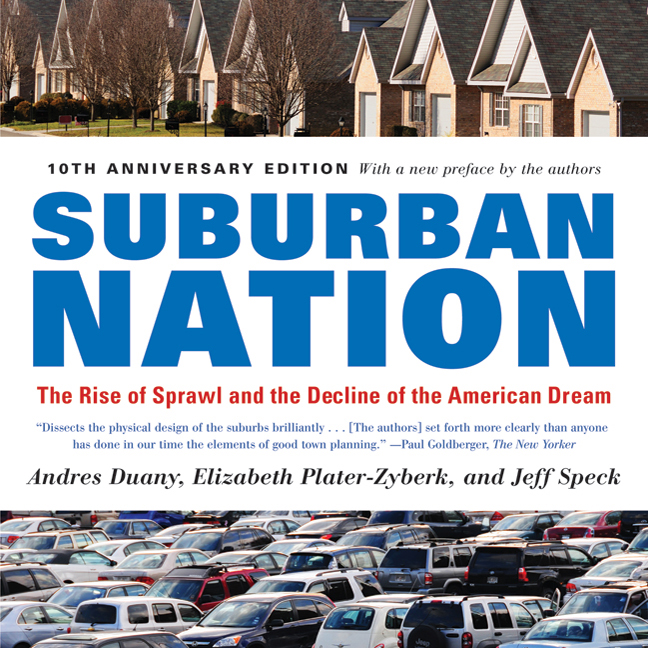
Despite its title, Suburban Nation: The Rise of Sprawl and the Decline of the American Dream, this book is only partially about suburbia; it also serves as a programmatic statement and justification for New Urbanist development. Andres Duany, Elizabeth Plater-Zyberk and Jeff Speck are architectural and city planners who designed the planned community of Seaside, Florida, and throughout Suburban Nation they argue that suburban sprawl is not bad because it is ugly. Rather, the authors (and their urban and suburban informants) argue that because there is a "causal relationship between the character of the physical environment and the social health of families and the community at large, suburbia is bad because it doesn't function to foster community and democracy. By contrast, communities modeled after "traditional American neighborhoods" can be aesthetically pleasing, make more efficient use of space, and cater to the needs of both individuals and the community.
122: Mona Domosh's Invented Cities
In Invented Cities: The Creation of Landscape in Nineteenth-Century New York and Boston, Mona Domosh examines the historical, economic, and cultural origins of city development in Boston and New York. Shows that in the 19th century, Boston and New York developed different spatial and architectural forms due to their different social/cultural structures, and that in both cases the physical and cultural structures mutually constituted the cities as different entities. However, in both cities, the cultural landscape of the city represented its middle and upper classes, who produced "visible representations of their individual and group beliefs, values, tensions, and fears" on the urban landscape. By applying a new cultural geography framework to urban landscape analysis, she brings 19th century urban development to life and shows how spatial patterns and culture shape one another.
114: Margaret Kohn's Brave New Neighborhoods
Margaret Kohn's Brave New Neighborhoods: The Privatization of Public Space argues that "public life is undermined by the growing phenomenon of private government" via the privatization of physical public spaces. As central business districts, parks, and other public gathering places are increasingly replaced with privately-owned shopping malls, gated communities, and Business Improvement Districts, true free speech and face-to-face political debate are foreclosed by bans on political speech or certain viewpoints (or even certain groups of people) on private property. As opposed to online forums, public space allows for debate in real time, among real, embodied people; it fosters the kind of informed opinions needed to keep a democracy running, so the loss of public space also has profound implications for the functioning of American politics.
Kohn bases her arguments in the historical uses of public space, legal cases regard the public/private status of malls, gated communities, and other privatized public spaces, and theories connecting physical spaces with political process. She argues that
112: David Harvey's From Space to Place
In "From Space to Place and Back Again," David Harvey theorizes the relationship between space and place as they relate to capital and globalization since 1970. Coming out of the Marxist tradition, Harvey argues that capitalism since 1970 has become global, and places are both nodes in the network of capital flows that are set up to catch and keep capital for as long as possible AND potential sites of resistance. These dual purposes of places are reflected in their material forms, representations of them, and symbolic landscapes within them, because places are constructed via struggle between residents and capital. Places thus exist somewhere between the universal and the particular in a global network of historical-geographical difference. Space, on the other hand, is abstract and wholly constructed by capital.
Harvey jumps through a lot of theoretical hoops to make this argument. The one that I least expected from him is also the most interesting: that Heidegger and Marx can be reconciled into a definition of place within global capitalism. Here, Marx's argument that repression, misconception, and exploitation are the result of a "purely place-based politics in a spatially dynamic capitalist world," combined with Heidegger's emphasis on place-based dwelling as an escape from modern capitalism, creates a definition of place as the site of both global capitalist exploitation AND place-based resistance, a site mutually constituted by the struggle between the global and the local.
My only question in all of this has to do with the nature of space. If place is the point of struggle between local dwelling and global capital flows, what is space? Where in the world is there no resistance to outside domination? I imagine even Monsanto cornfields in Kansas and the office buildings on Wall Street contain seeds of dissent somewhere.
Harvey jumps through a lot of theoretical hoops to make this argument. The one that I least expected from him is also the most interesting: that Heidegger and Marx can be reconciled into a definition of place within global capitalism. Here, Marx's argument that repression, misconception, and exploitation are the result of a "purely place-based politics in a spatially dynamic capitalist world," combined with Heidegger's emphasis on place-based dwelling as an escape from modern capitalism, creates a definition of place as the site of both global capitalist exploitation AND place-based resistance, a site mutually constituted by the struggle between the global and the local.
My only question in all of this has to do with the nature of space. If place is the point of struggle between local dwelling and global capital flows, what is space? Where in the world is there no resistance to outside domination? I imagine even Monsanto cornfields in Kansas and the office buildings on Wall Street contain seeds of dissent somewhere.
Labels:
capital flows,
capitalism,
Cultural Geography,
dialectic,
globalization,
local,
Marxism,
place and region,
space,
struggle
111: Mike Davis' City of Quartz
Mike Davis' City of Quartz: Excavating the Future in Los Angeles is about "the contradictory impact of economic globalization upon different segments of Los Angeles Society," where LA is both a specific place (that David clearly loves and is frustrated by) and a global city that "has come to play the double role of utopia and dystopia for advanced capitalism." Davis researched this book in the 1980s, when Reaganomics, the crack wars, increased socioeconomic disparity, law-and-order policing, and other anti-urban developments were wreaking havoc on LA; by putting LA in a global economic context, he is able to show that many of these problems are related to globalization, not poor domestic policy, and that fighting capitalism will have the biggest impact on urban welfare.
In an allusion to LA's film industry, Davis calls his method "noir," because 1940s film noir "insinuated contempt for a depraved business culture while it simultaneously searched for a critical mode of writing or filmmaking within it." Accordingly, the book is both a critique of LA and an investigation of how to make it better. Davis details the migration of LA's power elites from a post-WWI Downtown/Westside divide to suburbia to international banks, land monopolies, and global real estate holdings; the development of SoCal homeowners associations as racist, classist privatization; "fortress LA" and the privatization and militarization of urban life as a spatialized class war; the history of cocaine in LA as evidence of increasing wealth disparity; the dirty politics of LA's Catholic archdiocese, which is a huge employer and landholder in LA that prefers to be a space of law-and-order rather than one of resistance; and the plight of the suburbanized working class in an era of deindustrialization and decay.
Throughout, Davis' muckraking journalism digs through LA's many layers of complexity in expose after expose. As against other urban studies folks who write about globalization (like Saskia Sassen, for instance), Davis brings LA alive, reminding us of the power of its residents even as he implicates the city's elites in global networks of power.
In an allusion to LA's film industry, Davis calls his method "noir," because 1940s film noir "insinuated contempt for a depraved business culture while it simultaneously searched for a critical mode of writing or filmmaking within it." Accordingly, the book is both a critique of LA and an investigation of how to make it better. Davis details the migration of LA's power elites from a post-WWI Downtown/Westside divide to suburbia to international banks, land monopolies, and global real estate holdings; the development of SoCal homeowners associations as racist, classist privatization; "fortress LA" and the privatization and militarization of urban life as a spatialized class war; the history of cocaine in LA as evidence of increasing wealth disparity; the dirty politics of LA's Catholic archdiocese, which is a huge employer and landholder in LA that prefers to be a space of law-and-order rather than one of resistance; and the plight of the suburbanized working class in an era of deindustrialization and decay.
Throughout, Davis' muckraking journalism digs through LA's many layers of complexity in expose after expose. As against other urban studies folks who write about globalization (like Saskia Sassen, for instance), Davis brings LA alive, reminding us of the power of its residents even as he implicates the city's elites in global networks of power.
Sunday, April 7, 2013
107: Agee & Evans' Let Us Now Praise Famous Men
In July and August 1936, James Agee and Walker Evans were working on an article for a New York magazine in which they were to create a "photographic and verbal record" of "cotton tenantry in the United States." In particular, they were to write about "the daily living and environment of an average white family of tenant farmers." As it turned out, finding a "representative" sample of white tenant farmers proved difficult, but they found a group of three families and lived with them for less than four weeks, with Agee creating a written record and Evans taking photographs. The article was not published, and the book went through multiple publishers before finally coming out in 1939.
Let Us Now Praise Famous Men is, as Bill Stott argues, a beautifully-made 1930s documentary; Evans' photos have long since become iconic, and Agee's prose claims the entire beat generation as its descendants. Agee is also careful to situate himself and Evans as characters within the story of the tenant farmers' lives, so that the reader is clear throughout that the book combines objective reality and normative interpretation. The main argument of the book is encapsulated in the verse that serves as its title: "let us now praise famous men, and our fathers that begat us." The tension here is important: while the famous men lead us in creating history and are thus written down and remembered in history books, they are also responsible for the poverty in which his subjects live; while our fathers' names are never known to the world, they are arguably more important, because without fathers there would be no children, no next generation to pass history down to. Thus he celebrates the particularity of the human life of his subjects even as he critiques the universal structures that create it.
104: Don Mitchell's Cultural Geography
Don Mitchell's Cultural Geography: An Introduction is a critical introduction to cultural geography intended for graduate (or advanced undergraduate) students. By "critical," Mitchell means a) he takes a normative position (here, informed by Marxism and materialism) and makes an argument, and b) he invites his readers to question, argue, and struggle with both the points he makes and the arguments behind them, because this kind of intellectual engagement will help us learn. by "introduction to cultural geography," he means that the book explores the "struggles" that make "culture," both "to show how they get worked out in particular spaces and places - in particular landscapes - and to show how struggles over 'culture' are a key determinant, day in and day out, in the ways that we live our lives - and in what therefore constitutes significant cultural difference." Culture, in Mitchell's formulation, is a relational process and is always political; the production of cultural space is thus the production of particular geometries of power that give shape and meaning to our lives.
Labels:
capitalism,
Cultural Geography,
culture wars,
dialectic,
difference,
ideology,
landscape,
Marxism,
politics,
power,
struggle
102: Henri Lefebvre's The Production of Space
Henri
Lefebvre’s vast, multifaceted The
Production of Space could probably be said to advance any number of
arguments, but I think his most compelling argument is the one that brings
space and knowledge into a classical Marxist framework: capitalist Western
society is moving from the production of things in space to the production of
space itself, which means that capitalist powers are increasing their hold and
surveillance on ordinary people (aka space is now shaping the working
class). However, all is not lost: no
matter how much they try, the people who build and shape “dominant” space and
employ the working class can’t squeeze the working class out of existence or
keep them from “appropriating” and shaping space to suit their own needs, nor
can they make the world a completely visual, timeless, ideological
construct. Regular people have bodies,
and we live in specific places at specific historical moments, and we shape
those places (yeah, I said places, not spaces) into unique, historical “works
of art” that contrast with the partially commodified built environment
constructed by the ruling class. To say
that capitalism has moved beyond the product to space itself is to argue for
both an increasing attempt at totalizing control of society through space AND
increased resistance from the people who live in, experience, and shape that
space – with the potential for a socialist revolution where appropriated spaces
based on the human body/lived experience and use-value take precedence over
dominant, visual spaces and exchange-value.
101: David Harvey's Condition of Postmodernity
David Harvey's The Condition of Postmodernity both updates and spatializes classical Marxist theory and situates studies of place within the context of post-1973 global capitalism. He argues that postmodernity is a historical-geographical condition that is an aesthetic response to the crisis of overaccumulation. Throughout, he emphasizes the continuity from modernity to postmodernity, the connection between new cultural and economic practices, the post-1973 development of flexible capital accumulation on a global scale, and new ways of thinking about time-space compression. Some of his main points:
- modernity was at once transient, fleeting, contingent AND eternal and immutable; the project of Modernism was effectively the last hurrah of the Enlightenment project: to create a scientific narrative of chaos that could both rationalize internal social fragmentation within a narrative of Progress AND break from the past
- Postmodernism, on the other hand, celebrates difference, fragmentation, and the vernacular; it is spatial and pragmatic rather than temporal and abstract, and it revels in chaos and complexity. As opposed to the Modernist city, the PoMo city is not divided into functional zones but instead develops by its own logic into something apolitically beautiful in its chaos.
- Both Modernism and Postmodernism are dialectically related to their particular "regime of accumulation," the particular configuration of capitalists, workers, state employees, financiers, and other political-economic agents that stabilizes the net product between consumption and accumulation. In the first half of the 20th century, Fordism kept the regime of accumulation stable by slowly shaping global mass-production and mass-consumption into a core/periphery model with the US in the center.
Saturday, April 6, 2013
97: Penny Von Eschen's Race Against Empire
In Race Against Empire: Black Americans and Anticolonialism, 1937-1957, Penny Von Eschen locates radical black American thought within the larger tradition of politics of the African diaspora, and she traces the rise and fall of the relationship between the two in the decades surrounding WWII. The international politics of the African diaspora (or the Black Atlantic) combined local struggles against racism and colonialism with a broad critique of imperialism. International black leaders found support in Pan-Africanism, the Popular Front, labor movements in the US and the colonies, and a very vocal independent black press in the US; they viewed WWII as a unique opportunity to pursue their anti-colonial activism because they felt the racism and imperialism of the Axis powers would force the Allies to recognize and join their mission. This international context for radical black American thought provides context for the Civil Rights movement while detaching race from its American context and reconfiguring it as the internal contradiction in global capitalism.
Subscribe to:
Posts (Atom)