In Never Done: A History of American Housework, Susan Strasser argues that housework, the job done by more people in America than any other, "cannot be separated from the broader social and economic history of the United States." The women who did housework supported the men who built factories and cities, and the manufactured products and urban culture produced in those factories and cities in turn shaped women's housework. Strasser thus brings 19th century housewives into history AND provides an exhaustive history of household technologies.
Strasser is interested in what 19th century housewives actually did and what technologies they really used, not in the history of the technologies per se; the date that most households seemed to have a particular kind of technology and how most housewives seemed to use it are a lot more important to her than the date the technology was patented or the technological innovations that went into it or when the first privileged few got ahold of it. Therefore, she uses new social history methodologies to access her subject. Her sources include reformers' reports on intolerable living conditions, government documents on standards of living, sociologists' descriptions of daily life, manufacturers' market research, ads, catalogues, travel accounts, letters, and advice manuals, cookbooks, and women's magazines. In all of these sources, she's looking not so much at the opinions or prescriptive advice but at the ways in which particular technologies and practices are framed - as new, old-fashioned, commonplace, etc. This strategy allows her to approximate what American housewives' lives might have been like at different points in time form 1850 to 1930.
Showing posts with label class. Show all posts
Thursday, April 11, 2013
Monday, April 8, 2013
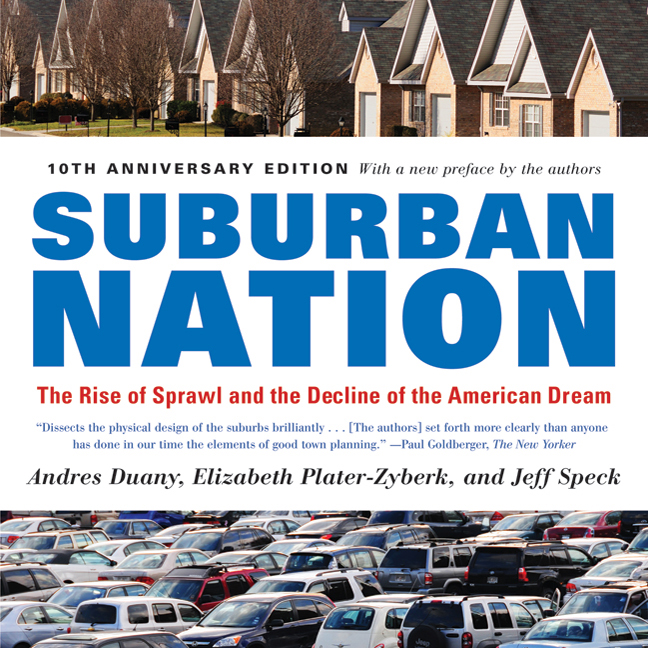
123: Duany, Plater-Zyberk & Speck's Suburban Nation
Despite its title, Suburban Nation: The Rise of Sprawl and the Decline of the American Dream, this book is only partially about suburbia; it also serves as a programmatic statement and justification for New Urbanist development. Andres Duany, Elizabeth Plater-Zyberk and Jeff Speck are architectural and city planners who designed the planned community of Seaside, Florida, and throughout Suburban Nation they argue that suburban sprawl is not bad because it is ugly. Rather, the authors (and their urban and suburban informants) argue that because there is a "causal relationship between the character of the physical environment and the social health of families and the community at large, suburbia is bad because it doesn't function to foster community and democracy. By contrast, communities modeled after "traditional American neighborhoods" can be aesthetically pleasing, make more efficient use of space, and cater to the needs of both individuals and the community.
Sunday, April 7, 2013
102: Henri Lefebvre's The Production of Space
Henri
Lefebvre’s vast, multifaceted The
Production of Space could probably be said to advance any number of
arguments, but I think his most compelling argument is the one that brings
space and knowledge into a classical Marxist framework: capitalist Western
society is moving from the production of things in space to the production of
space itself, which means that capitalist powers are increasing their hold and
surveillance on ordinary people (aka space is now shaping the working
class). However, all is not lost: no
matter how much they try, the people who build and shape “dominant” space and
employ the working class can’t squeeze the working class out of existence or
keep them from “appropriating” and shaping space to suit their own needs, nor
can they make the world a completely visual, timeless, ideological
construct. Regular people have bodies,
and we live in specific places at specific historical moments, and we shape
those places (yeah, I said places, not spaces) into unique, historical “works
of art” that contrast with the partially commodified built environment
constructed by the ruling class. To say
that capitalism has moved beyond the product to space itself is to argue for
both an increasing attempt at totalizing control of society through space AND
increased resistance from the people who live in, experience, and shape that
space – with the potential for a socialist revolution where appropriated spaces
based on the human body/lived experience and use-value take precedence over
dominant, visual spaces and exchange-value.
Saturday, April 6, 2013
86: James Grossman's Land of Hope
James Grossman's Land of Hope: Chicago, Black Southerners, and the Great Migration looks at the Great Black Migration as a social process of migration and adaptation that linked together North and South, culturally as well as geographically. Grossman works in the new social history tradition, so his interest is in the experiences and decisions made by black Southerners who participated in the migration, as well as in their perceptions of their new lives in Chicago.
Looking at the Migration from the perspective of black Southerners, Grossman discovers that the decision to move North was made by the migrants themselves, not by larger structural forces. The migrants evaluated the North based on the world they knew in the South, not abstract notions of equality. And initially, Chicago really was a land of hope: the city offered higher wages, more autonomy, the ability to vote, and better schools for their children than were available in the South. While some historians interpret the migration as a structural shift from rural to urban work, Grossman argues that it was a conscious move by black Southerners to gain opportunity and freedom.
Friday, April 5, 2013
80: Nan Boyd's Wide Open Town
In
Wide Open Town, Nan Boyd argues that
San Francisco’s bar-based queer culture was just as important to the
development of the gay and lesbian civil rights movement there as were the
city’s more mainstream activist groups. The
book relies primarily on some 40 oral histories with San Francisco bargoers,
owners, and LGBT rights activists, as well as tourist guides, periodicals,
clippings, photographs, and public records to construct (in often meticulous
detail) a narrative of how the development of San Francisco’s gay scene swelled
into a fight for civil rights. Although
the writing style is a bit heavy-handed at times, Boyd’s innovative research
and methodology create a narrative that is anything but closed or canonical. Rather, by limiting her scope to San
Francisco before 1965 and structuring the book in terms of community formation
rather than strict chronology, Boyd is able to open up the development of San
Francisco’s gay civil rights movement and analyze (or characterize) it in terms
of a variety of local contextual factors.
As she moves through topics as diverse as the gay male community,
tourism, and female impersonation; the lesbian community, prostitution, and the
female body; policing and the construction of homosexuality as behavior- versus
desire-based; homophile activism and class-based differences over separatism
and assimilation; and coalition-building, she explores the relationships
between economics, use of space, police and media oppression, and the development
of a community into a class-for-itself.
The result is a narrative that characterizes San Francisco’s gay civil
rights movement as a multi-class, space- and place-dependent grassroots
movement. Boyd’s work thus argues that,
for this movement in this place and time, “the politics of everyday life were
every bit as important as the politics of organized social movement activism.”
(242)
70: Eric Foner's Reconstruction
Eric Foner's Reconstruction: America's Unfinished Revolution, 1863-1877 is a synthetic history of American Reconstruction that combines social, political, and economic aspects of Reconstruction into three overarching themes:
- the centrality of black experience
- the larger context of an emergent national state
- the impact of social, political, economic, and moral developments in the North affected the course of Reconstruction in the South
66: George Chauncey's Gay New York
George Chauncey's Gay New York: Gender, Urban Culture, and the Making of the Gay Male World, 1890-1940 uses archival and oral sources to debunk three myths about gay male culture in turn-of-the-century New York: the myth of isolation, the myth of invisibility, and the myth of internalization. In doing so, he shows that a well-developed gay culture existed in New York long before Stonewall. Further, by reconstructing the spaces, symbols, events and people that made up gay male culture from the turn of the century to WWII, he both establishes the social construction of a gay male identity and argues against any cultural analysis that posits linear progress or a liberation politics as a key component of this identity.
Chauncey studies the development of gay culture in four New York neighborhoods: the Bowery, Greenwich Village, Harlem, and Times Square, and tries to pinpoint the moments when a gay presence became visible in each. He bases his argument on a huge quantity of primary materials, including police and trial records, diaries, documents from the District Attorney's office and the city magistrate, records of the Society for the Suppression of Vice, the Committee of Fourteen, and anti-prostitution organizations, and old gossip sheets like the Broadway Brevities. And the worlds that he meticulously reconstructs from this mountain of empirical data reveal several unique cultural patterns: gay rituals and institutions that foster a collective identity, gay migration patterns that parallel ethnic migration patterns, a kind of semiotic ingenuity that allowed many men to lead double lives, and a consistent definition of homosexuality as the passive acceptance of penetration rather than as a desire for someone of the same sex. This behavior-based definition allowed working-class and middle-class men in modernizing New York to treat "fairies" in the same way that they would female prostitutes, while the myriad spaces of New York's permissive sexual underworld (including the rooms at the YMCA) allowed for a flowering of gay sexualities and sexual expression, especially during Prohibition. By the 1930s, pansy culture provided opportunities for voyeuristic escape from middle-class life, even as gay culture was increasingly seen as a threat to the post-Prohibition moral order.
Throughout, Gay New York builds an interpretation of culture from empirical evidence about particular spaces, performances, people, and objects in New York. Chauncey thus locates gay male culture in both a particular time and place and a particular social, economic, and cultural milieu: a modern New York grappling with the social upheaval of industrial capitalism.
Chauncey studies the development of gay culture in four New York neighborhoods: the Bowery, Greenwich Village, Harlem, and Times Square, and tries to pinpoint the moments when a gay presence became visible in each. He bases his argument on a huge quantity of primary materials, including police and trial records, diaries, documents from the District Attorney's office and the city magistrate, records of the Society for the Suppression of Vice, the Committee of Fourteen, and anti-prostitution organizations, and old gossip sheets like the Broadway Brevities. And the worlds that he meticulously reconstructs from this mountain of empirical data reveal several unique cultural patterns: gay rituals and institutions that foster a collective identity, gay migration patterns that parallel ethnic migration patterns, a kind of semiotic ingenuity that allowed many men to lead double lives, and a consistent definition of homosexuality as the passive acceptance of penetration rather than as a desire for someone of the same sex. This behavior-based definition allowed working-class and middle-class men in modernizing New York to treat "fairies" in the same way that they would female prostitutes, while the myriad spaces of New York's permissive sexual underworld (including the rooms at the YMCA) allowed for a flowering of gay sexualities and sexual expression, especially during Prohibition. By the 1930s, pansy culture provided opportunities for voyeuristic escape from middle-class life, even as gay culture was increasingly seen as a threat to the post-Prohibition moral order.
Throughout, Gay New York builds an interpretation of culture from empirical evidence about particular spaces, performances, people, and objects in New York. Chauncey thus locates gay male culture in both a particular time and place and a particular social, economic, and cultural milieu: a modern New York grappling with the social upheaval of industrial capitalism.
Labels:
American Studies,
class,
culture,
discourse,
escapism,
modernity,
New York,
performance,
sexuality,
spatial turn
Thursday, April 4, 2013
64: Sean Wilentz' Chants Democratic
In Chants Democratic, New York City and the Rise of the American Working Class, 1788-1850, Sean Wilentz describes the process of "metropolitan industrialization" - aka the alienation of labor - and its impact on emerging class relationships in New York during the Jacksonian era. In particular, he's interested in the development of class consciousness among the city's artisans. Like other scholars indebted to E.P. Thompson and the new social history, Wilentz is profoundly interested in the whole lives and particularly the agency of his subjects, but he is careful to integrate the world of the artisans into a more traditional economic and political framework. He combines these micro/macro approaches to argue that class formation was critical to the social and political crises of the era.
61: Alexander Saxton's Rise and Fall of the White Republic
In The Rise and Fall of the White Republic: Class Politics and Mass Culture in Nineteenth-Century America, Alexander Saxton investigates a key question for historians of the antebellum era in America: how and why did a nation founded on principles of equality and democracy become so fraught with racial inequality? To answer this question, he takes an "ideological" approach to 19th century American history, in which he connects political ideas, economic and social practices, and cultural production and consumption into an emergent American worldview. And by analyzing a variety of texts, from high political discourse to popular forms like blackface, dime novels, and American folk heroes, he shows that the development of a dominant capitalist ideology in nineteenth-century America was intimately tied to white racism.
Rise and Fall is framed around the rise and fall of different political parties in a three-stage dialectical process: the National Republicans or Whigs, whose emphasis on business-friendly hierarchy and racial hierarchy created a kind of structural "soft" racism; the Jacksonians, who combined active racism with the language of equal opportunity to create white populism; and the "Republican synthesis," which supported both white populism and business-friendly tariffs, infrastructural development, and expansion policies. Thus, the ideology of white racism developed out of elites' need to vindicate themselves for profiting from the slave trade and slave labor within the new Republic's democratic ideals.
Unlike Roediger, who argues that working class whites created racism as a way to feel better about their reduced economic and political power in early industrialization, Saxton argues that racism has a large top-down component: the populists use it to unite poor and rich whites into a single, popular class that erases white guilt for profiting off slavery. Sean Wilentz hammers this difference home when he argues that Saxton never quite explains why white workers would act against their own class interests and participate in a Populist ideological project. However, despite this very valid critique, Saxton's book compliments Roediger's by examining the process of racialization from an upper-class instead of a working-class position, and by showing that racism continued to operate in the US long after the need to justify slavery had been met because it helped solidify the power of various class coalitions.
Rise and Fall is framed around the rise and fall of different political parties in a three-stage dialectical process: the National Republicans or Whigs, whose emphasis on business-friendly hierarchy and racial hierarchy created a kind of structural "soft" racism; the Jacksonians, who combined active racism with the language of equal opportunity to create white populism; and the "Republican synthesis," which supported both white populism and business-friendly tariffs, infrastructural development, and expansion policies. Thus, the ideology of white racism developed out of elites' need to vindicate themselves for profiting from the slave trade and slave labor within the new Republic's democratic ideals.
Unlike Roediger, who argues that working class whites created racism as a way to feel better about their reduced economic and political power in early industrialization, Saxton argues that racism has a large top-down component: the populists use it to unite poor and rich whites into a single, popular class that erases white guilt for profiting off slavery. Sean Wilentz hammers this difference home when he argues that Saxton never quite explains why white workers would act against their own class interests and participate in a Populist ideological project. However, despite this very valid critique, Saxton's book compliments Roediger's by examining the process of racialization from an upper-class instead of a working-class position, and by showing that racism continued to operate in the US long after the need to justify slavery had been met because it helped solidify the power of various class coalitions.
Labels:
American Studies,
antebellum,
blackface,
class,
dialectic,
ideology,
race,
racism,
whiteness
60: David Roediger's Wages of Whiteness
In Wages of Whiteness, David Roediger argues that whiteness is an ideology that was constructed in the 19th-century, when working-class whites responded to the increased wage dependence, standardization, and discipline attached to the Industrial Revolution by separating themselves from blacks, demonizing them, and accepting the "public and psychological" value of whiteness as part of their wage. The compensation of these "wages of whiteness" led to a kind of self oppression, which both made them willing to accept a lot more misery than they would otherwise have taken and kept them from organizing with black workers against their mutual exploitation.
This deceptively simple argument has several constituent parts, as Roediger pulls from an updated classical Marxism, new labor history, new social history, and theories of racism to delineate the development of whiteness and connect it to the formation of the working class in the early 19th century. Critical to his argument is the expansion of Marxist theory to include race: he argues that race cannot be reduced to class, and that the two social categories work in dialectic with one another. From the new labor/ new social history, he pulls the insistence that working class people are historical agents, not dupes controlled by capital, and that they are thus complicit in the construction of their own racism. And he builds on existing theories of race, racism and slavery (most notably George Rawick) to show that racism developed as a response to early 19th-century capitalist development, of which slavery was a constituent part: nostalgia for a pre-industrial past, combined with frustration at their own proletarianization, resulted in white working-class racism and hatred toward black slaves as emblems of both preindustrial peasants and industrial capitalist workers. From there, the step to racism as a constituent element of white working class identity was a small one.
The rest of the book includes two case studies that Roediger largely pulls from secondary sources: blackface minstrelsy as a way to provide an outlet for white racial tensions and frustrations; and the story of how the black Irish adopted racism against blacks to assume a white American identity. In both cases, Roediger shows how racism both constructs and masks the blackness that is at the heart of whiteness. While I was surprised to find that such an innovative and hugely influential thesis is built on secondary evidence and conjecture more than empirical research, I think the case studies illustrate Roediger's argument well, and I really like his innovative use of developments in studies of race, slavery, and the working class that came out of the new social history.
This deceptively simple argument has several constituent parts, as Roediger pulls from an updated classical Marxism, new labor history, new social history, and theories of racism to delineate the development of whiteness and connect it to the formation of the working class in the early 19th century. Critical to his argument is the expansion of Marxist theory to include race: he argues that race cannot be reduced to class, and that the two social categories work in dialectic with one another. From the new labor/ new social history, he pulls the insistence that working class people are historical agents, not dupes controlled by capital, and that they are thus complicit in the construction of their own racism. And he builds on existing theories of race, racism and slavery (most notably George Rawick) to show that racism developed as a response to early 19th-century capitalist development, of which slavery was a constituent part: nostalgia for a pre-industrial past, combined with frustration at their own proletarianization, resulted in white working-class racism and hatred toward black slaves as emblems of both preindustrial peasants and industrial capitalist workers. From there, the step to racism as a constituent element of white working class identity was a small one.
The rest of the book includes two case studies that Roediger largely pulls from secondary sources: blackface minstrelsy as a way to provide an outlet for white racial tensions and frustrations; and the story of how the black Irish adopted racism against blacks to assume a white American identity. In both cases, Roediger shows how racism both constructs and masks the blackness that is at the heart of whiteness. While I was surprised to find that such an innovative and hugely influential thesis is built on secondary evidence and conjecture more than empirical research, I think the case studies illustrate Roediger's argument well, and I really like his innovative use of developments in studies of race, slavery, and the working class that came out of the new social history.
Wednesday, April 3, 2013
58: James Oakes' The Ruling Race
In the early 1980s, while new social historians were focusing on the internal dynamics of slave communities, James Oakes was using quantitative methods to understand the diverse conditions and experiences that made up slaveholding culture. In The Ruling Race: A History of American Slaveholders, Oakes strongly critiques Eugene Genovese's conception of a relatively homogeneous paternalistic "master class;" he argues that slaveholding culture varied over time and was different in different places. He also argues that slavery was a capitalist enterprise, not precapitalist, and thus that its implications need to be considered within the broader context of American capitalist development.
Labels:
American Studies,
antebellum,
capitalism,
class,
geography,
slaveholders,
slavery
53: Evelyn Brooks Higginbotham's African-American Women's History
In her 1992 article "African-American Women's History and the Metalanguage of race," Evelyn Brooks Higginbotham argues that feminist scholars need to bring race into their analysis of social power. Race for Higginbotham is both a "decentered complex of social meanings constantly being transformed by political struggle" AND a "metalanguage" that has a "powerful, all-encompassing effect on the construction and representation of other social and power relations." Integrating race and gender into a study of social power de-homogenizes both sides of the equation: racializing gender challenges the assumption that all women are the same, and gendering race challenges the assumption that all people of a particular race are the same. Destabilizing these two categories also helps make other social divisions, like class, visible within them. And all of this destabilization gives us a more nuanced picture of the relations of power in American society.
In the course of challenging the homogeneity of race and class, Higginbotham draws on plenty of cultural theory to analyze speeches and writings by black intellectuals and white feminist scholars, court cases, and histories of mostly 19th-century black experiences as well as some 20th-century examples. In the process, she historicizes the development of race as a tool of oppression that is rooted in slavery; because race thus signifies the master/slave relationship, it exists as ideology on top of class and property relations and conditions gender and sexuality. However, because race develops out of material relations of oppression between groups, it also serves as what Bakhtin calls a "double-voiced discourse:" race is simultaneously the language of black oppression AND black liberation. And, recognizing the liberatory possibilities of racial discourse, Higginbotham concludes with a call for black female historians to write race into gender by writing histories that open up spaces for agency; we will become fully human in and through discourse.
While I'm concerned about what feels like a cherrypicking approach in her choice of examples, and even more concerned that she seems to be more interested in discourse than in real, material actions and places, I think her call to look for the intersections and divisions in race and gender as categories can lead to very productive thinking about power in a more holistic way.
In the course of challenging the homogeneity of race and class, Higginbotham draws on plenty of cultural theory to analyze speeches and writings by black intellectuals and white feminist scholars, court cases, and histories of mostly 19th-century black experiences as well as some 20th-century examples. In the process, she historicizes the development of race as a tool of oppression that is rooted in slavery; because race thus signifies the master/slave relationship, it exists as ideology on top of class and property relations and conditions gender and sexuality. However, because race develops out of material relations of oppression between groups, it also serves as what Bakhtin calls a "double-voiced discourse:" race is simultaneously the language of black oppression AND black liberation. And, recognizing the liberatory possibilities of racial discourse, Higginbotham concludes with a call for black female historians to write race into gender by writing histories that open up spaces for agency; we will become fully human in and through discourse.
While I'm concerned about what feels like a cherrypicking approach in her choice of examples, and even more concerned that she seems to be more interested in discourse than in real, material actions and places, I think her call to look for the intersections and divisions in race and gender as categories can lead to very productive thinking about power in a more holistic way.
Labels:
African American,
American Studies,
class,
class struggle,
cultural theory,
gender,
metalanguage,
power,
race,
sexuality
Tuesday, April 2, 2013
47: Edmund Morgan's American Slavery, American Freedom
In American Slavery, American Freedom: The Ordeal of Colonial Virginia, Edmund Morgan studies the social and political history of Virginia from the 1580s to about 1720, and he argues that the supposed political harmony and freedom in Virginia after 1730 was symbiotically related to the enslavement of black people - freedom and slavery didn't just co-exist; they mutually constructed one another.
Apparently the trajectory of Virginia's growth closely followed the pattern set out by Jack Greene in In Pursuit of Happiness: small and disorganized in Jamestown; then a tobacco boom starting in 1615, which creates huge disparities of wealth between planters and workers, as well as high mortality and increased individualism; then social stabilization from 1630 to 1680, when the mortality rate dropped and, despite Bacon's Rebellion in 1670, elites centralized control; and then the increased substitution of slavery after 1680, which solved the problem of freed indentured servants wanting land and, through racism, created a bond between lower and upper-class whites. And racism, combined with 18th century ideology of the common man and a dwindling number of non-landowning whites, froze social relations and neutralized dissent in a way that allowed elites to support freedom and slavery to be the thing that held freedom up.
This thesis - that freedom and exploitation are intertwined - seems like a pretty classic Marxist argument to me. What Morgan adds to the equation is the development of racism as a consciously applied tool of capitalist exploitation. I'm a little confused about how, exactly, racism comes about - do the elites invent it? Do the roving bands of unemployed former indentured servants invent it? Is is already in the air because of experience with Native Americans? But regardless of origins, this idea of racism as a tool of economic oppression is now pervasive in whiteness studies, so maybe he's on to something.
Apparently the trajectory of Virginia's growth closely followed the pattern set out by Jack Greene in In Pursuit of Happiness: small and disorganized in Jamestown; then a tobacco boom starting in 1615, which creates huge disparities of wealth between planters and workers, as well as high mortality and increased individualism; then social stabilization from 1630 to 1680, when the mortality rate dropped and, despite Bacon's Rebellion in 1670, elites centralized control; and then the increased substitution of slavery after 1680, which solved the problem of freed indentured servants wanting land and, through racism, created a bond between lower and upper-class whites. And racism, combined with 18th century ideology of the common man and a dwindling number of non-landowning whites, froze social relations and neutralized dissent in a way that allowed elites to support freedom and slavery to be the thing that held freedom up.
This thesis - that freedom and exploitation are intertwined - seems like a pretty classic Marxist argument to me. What Morgan adds to the equation is the development of racism as a consciously applied tool of capitalist exploitation. I'm a little confused about how, exactly, racism comes about - do the elites invent it? Do the roving bands of unemployed former indentured servants invent it? Is is already in the air because of experience with Native Americans? But regardless of origins, this idea of racism as a tool of economic oppression is now pervasive in whiteness studies, so maybe he's on to something.
Labels:
American Studies,
class,
colonial America,
freedom,
ideology,
individualism,
liberty,
race,
racism,
slavery,
Virginia
Wednesday, January 23, 2013
24: Laura Pulido's Black, Brown, Yellow and Left
Laura Pulido squeezes several agendas into this book. As an LA activist who worked with an antiracist, anticapitalist group called the Labor/Community Strategy Center to organize a multiethnic left, she is interested in learning from the history and mechanics of previous multi-racial organizing attempts; she is also interested in fostering a class-based leftist politics among her readers. As a scholar, she is fascinated by the sixties and frustrated that histories of radicalism in that period are either mostly white or centered around the Black Panther Party, so she wants to expand the history of racial/ethnic activism to incorporate more of LA's racial and ethnic groups; and she wants to complicate racism by breaking down the black white binary and investigating racial hierarchies and collaborations (or not) in the people she is studying.
Therefore, Black, Brown, Yellow and Left is part history of the Third World Left, part empirical study of what she calls "differential racism," and part analysis of the growth, development, and decline of a social movement. Pulido accomplishes all of these goals via a comparative analysis of left-leaning activism among three racial/ethnic groups in LA in the late 1960s and early 1970s, using three organizations as stand-ins: the Black Panther Party for African Americans; East Wind, a Japanese American group, for Asian Americans; and CASA, a Chicano/a group, for Latino/as.Although the details of each case make for good reading, her historical conclusions about the relationship between race/ethnicity, racism, and Left activism reveal the complexities of the Third World Left. Her study of the Black Panther Party suggests that their two main concerns of self-defense and community service were directly related to African American racialization (as the 'Other' to whites, they were at the very bottom of the racial hierarchy and over-policed) and their class position as urban poor. CASA, by contrast, focused on labor organizing and immigration issues reflected Chicano/as position as a 'problem minority': their racial status and particular historical experiences as immigrants and low-wage workers meant that they were a needed part of the economy, but only as subordinated and exploited workers. And as a Japanese American group in a multiethnic, multi-class Asian American community, East Wind focused on issues of identity, community service, and solidarity work; their activities reflected their mixed economic position and their status as a 'middle minority.'
Though Pulido found enough connections among groups to indicate a relatively coherent Third World Left, she quickly discovered that these connections were rather thin. All three organizations were interested in the connection between their own identity as a racial or ethnic 'nation' and anticolonial struggles worldwide, and all three were fighting racism and economic exploitation at home, but they were unsure how to work with other communities in LA. This uncertainty had a lot to do with the complex racial hierarchies in LA at the time: African Americans, for instance, were at the bottom of the social hierarchy, but through the millitancy and visibility of the Black Panther Party they were at the top of the social movement hierarchy. Uncertain positioning, as well as uncertainty regarding the status of one's own group, made lasting coalitions difficult.
Pulido argues that despite a strong need for a multiethnic left today, the situation is much the same as it was in the 1960s and 1970s: strong ethnic groups with weak connections among them, and a weak Third World Left as a result. Despite some issues with scope (using a single organization to stand in for all ethnic/racial organizing, for instance), Pulido's book provides a thoughtful analysis of the intersections between race and class in LA that may well be a useful guidebook for folks trying to build political capital today.
Thursday, January 10, 2013
15: Agee & Evans' Let Us Now Praise Famous Men
After days of pounding through historians, sociologists, and geographers, poring over the iconic images and arresting prose of Let Us Now Praise Famous Men makes me feel alive again. (Hey, I was an English major for a reason!)
Nominally, James Agee and Walker Evans' book is a study of three (white) sharecropping families in rural Alabama in summer 1936, the Ricketts, the Gudgers, and the Woods. But as James Agee argues in the book's opening pages, it is much, much more than that. It is a full, thorough, truthful account of their subjects in both narrative and photographic form; a conversation, albeit limited by the asynchronous nature of their chosen medium, among the families, the writer and photographer, and the reader; an indictment of the capitalist system that abuses those lowest in its hierarchy; a study of the humanity of the poor; and - let's be honest - a way to make a little money for Agee and Evans, too.
Both photos and narrative touch on all of these themes in depth, but the most central one, I think, is the humanity - both unique to them and common to all people - of the tenant families themselves. And, possibly because they lived with George and Annie Mae Gudger for the four weeks of their study, or because this couple was closest to their own age but occupying such a different part of the socioeconomic hierarchy, both Agee and Evans express this theme best with respect to George Gudger.
Since Evans' image of Gudger comes first in the book, he gets to speak first here.
I'm not the best at reading images, but I will say this: from the distance of nearly 80 years, this image is very much the image of the depression: the gritty black-and-white exposure, the half-clean shirt and overalls, the rough background, the eyes looking directly into the camera in a mixture of strength, frustration, and despair. It is the stuff that American ideology is made of: the depression may have beaten America down, but the people are determined, and we will win! But there are so many different emotions playing out at once in Gudger's face, and the tight framing of the photo accentuates not the poverty of his surroundings, but him: in creating this portrait, Evans has allowed a single man to express the way he feels about how his life is turning out, and simultaneously created something that speaks to many, many people who've been there.
Agee, no less poetic, describes Gudger in this way:
George Gudger is a human being, a man, not like any other human being so much as he is like himself…. [S]omehow a much more important, and dignified, and true fact about him than I could conceivably invent, though I were an illimitably better artist than I am, is that fact that he is exactly, down to the last inch and instant, who, what, were, when and why he is. He is in those terms living, right now, in flesh and blood and breathing, in an actual part of a world in which also, quite as irrelevant to imagination, you and I are living. Granted that beside that fact it is a small thing, and granted also that it is essentially and finally a hopeless one, to try merely to reproduce and communicate his living as nearly exactly as possible, nevertheless I can think of no worthier and many worse subjects of attempt.
Like Evans, Agee describes Gudger as both a "human being, a man" and "himself;" he belongs simultaneously to his own day to day life and to the world of "you and I;" he is at once irreplicable and reproducible.
This theme, by the way, ties in nicely with the title of the book; the second half of the verse that begins "let us now praise famous men," which Agee intentionally leaves out, only to append at the end, is "and our fathers that begat us" - irreplicable but reproducible men in their own right.
Nominally, James Agee and Walker Evans' book is a study of three (white) sharecropping families in rural Alabama in summer 1936, the Ricketts, the Gudgers, and the Woods. But as James Agee argues in the book's opening pages, it is much, much more than that. It is a full, thorough, truthful account of their subjects in both narrative and photographic form; a conversation, albeit limited by the asynchronous nature of their chosen medium, among the families, the writer and photographer, and the reader; an indictment of the capitalist system that abuses those lowest in its hierarchy; a study of the humanity of the poor; and - let's be honest - a way to make a little money for Agee and Evans, too.
Both photos and narrative touch on all of these themes in depth, but the most central one, I think, is the humanity - both unique to them and common to all people - of the tenant families themselves. And, possibly because they lived with George and Annie Mae Gudger for the four weeks of their study, or because this couple was closest to their own age but occupying such a different part of the socioeconomic hierarchy, both Agee and Evans express this theme best with respect to George Gudger.
Since Evans' image of Gudger comes first in the book, he gets to speak first here.
I'm not the best at reading images, but I will say this: from the distance of nearly 80 years, this image is very much the image of the depression: the gritty black-and-white exposure, the half-clean shirt and overalls, the rough background, the eyes looking directly into the camera in a mixture of strength, frustration, and despair. It is the stuff that American ideology is made of: the depression may have beaten America down, but the people are determined, and we will win! But there are so many different emotions playing out at once in Gudger's face, and the tight framing of the photo accentuates not the poverty of his surroundings, but him: in creating this portrait, Evans has allowed a single man to express the way he feels about how his life is turning out, and simultaneously created something that speaks to many, many people who've been there.
Agee, no less poetic, describes Gudger in this way:
George Gudger is a human being, a man, not like any other human being so much as he is like himself…. [S]omehow a much more important, and dignified, and true fact about him than I could conceivably invent, though I were an illimitably better artist than I am, is that fact that he is exactly, down to the last inch and instant, who, what, were, when and why he is. He is in those terms living, right now, in flesh and blood and breathing, in an actual part of a world in which also, quite as irrelevant to imagination, you and I are living. Granted that beside that fact it is a small thing, and granted also that it is essentially and finally a hopeless one, to try merely to reproduce and communicate his living as nearly exactly as possible, nevertheless I can think of no worthier and many worse subjects of attempt.
Like Evans, Agee describes Gudger as both a "human being, a man" and "himself;" he belongs simultaneously to his own day to day life and to the world of "you and I;" he is at once irreplicable and reproducible.
This theme, by the way, ties in nicely with the title of the book; the second half of the verse that begins "let us now praise famous men," which Agee intentionally leaves out, only to append at the end, is "and our fathers that begat us" - irreplicable but reproducible men in their own right.
14: W.E.B. Du Bois' The Philadelphia Negro
W.E.B. Du Bois' The Philadelphia Negro is a sociological study of the black population in Philadephia at the turn of the century. It was commissioned by Progressive reformers interested in understanding and reducing the high rates of poverty and crime then attributed to the black community, and it contains empirical data culled from thousands of personal interviews that Du Bois conducted with Philly's black residents. It touches on everything from family structure, occupations, and health to the class hierarchies within the black community and the impacts of racism and segregation on the landscape.
Du Bois was kind of a badass. He only had enough funding from U-Penn to spend a year on this study and not enough to hire anyone to help him, so he personally interviewed thousands of Philly's black residents and then compiled all of the data himself. Where possible, he also compared the trends he found in his data to data from similar studies. I have no idea how he slept or when he ate.
The results of this study, and Du Bois' interpretation of them, are freakishly similar to conditions and interpretations today.
His map of the 7th ward, for instance, where roughly 40% of Philly's black population lived, shows evidence of enforced segregation, as black homes and white homes are rarely on the same block, and black families pay more for poorer housing than do white families.
The map also shows evidence of social stratification within the black community, as middle-class black families may live on the same tree-lined sections of Lombard street as working-class families, but the poor and the "vicious and criminal classes" are concentrated in alley tenements and in Minister Street between 7th and 8th.
His study of death rates and causes of death shows that the black population has much higher death rates than does Philly's population at large, that the highest death rates are in wards with the poorest sanitation and most overcrowding, and that the majority of these deaths (outside of stillbirths) are from diseases directly related to these poor living conditions: consumption, pneumonia, and urinary tract infections.
And his study of occupations and demographics shows that though the community does have its share of professionals and middle-class workers, the vast majority of black workers are employed in domestic service, and no one works in industry - an occupational composition he attributes to discriminatory hiring practices and industrial union racism.
Even though it was written more than a century ago, this book feels like contemporary work by William Julius Wilson or Massey & Denton, who argue, like Du Bois, that restricting housing and employment opportunities for an entire group of people and then blaming that group for being slow to raise itself out of poverty is racist, illogical, and unfair (not to mention essentialist and just plain ridiculous.) That Du Bois' work languished in obscurity for almost fifty years due to that same racist, illogical, and unfair mindset, and that the problems he addressed empirically a century ago are still issues today - well, I can't think of any more frustrating or more powerful evidence of the enduring power of fear, racism, and hate.
Du Bois was kind of a badass. He only had enough funding from U-Penn to spend a year on this study and not enough to hire anyone to help him, so he personally interviewed thousands of Philly's black residents and then compiled all of the data himself. Where possible, he also compared the trends he found in his data to data from similar studies. I have no idea how he slept or when he ate.
The results of this study, and Du Bois' interpretation of them, are freakishly similar to conditions and interpretations today.
His map of the 7th ward, for instance, where roughly 40% of Philly's black population lived, shows evidence of enforced segregation, as black homes and white homes are rarely on the same block, and black families pay more for poorer housing than do white families.
The map also shows evidence of social stratification within the black community, as middle-class black families may live on the same tree-lined sections of Lombard street as working-class families, but the poor and the "vicious and criminal classes" are concentrated in alley tenements and in Minister Street between 7th and 8th.
His study of death rates and causes of death shows that the black population has much higher death rates than does Philly's population at large, that the highest death rates are in wards with the poorest sanitation and most overcrowding, and that the majority of these deaths (outside of stillbirths) are from diseases directly related to these poor living conditions: consumption, pneumonia, and urinary tract infections.
And his study of occupations and demographics shows that though the community does have its share of professionals and middle-class workers, the vast majority of black workers are employed in domestic service, and no one works in industry - an occupational composition he attributes to discriminatory hiring practices and industrial union racism.
Even though it was written more than a century ago, this book feels like contemporary work by William Julius Wilson or Massey & Denton, who argue, like Du Bois, that restricting housing and employment opportunities for an entire group of people and then blaming that group for being slow to raise itself out of poverty is racist, illogical, and unfair (not to mention essentialist and just plain ridiculous.) That Du Bois' work languished in obscurity for almost fifty years due to that same racist, illogical, and unfair mindset, and that the problems he addressed empirically a century ago are still issues today - well, I can't think of any more frustrating or more powerful evidence of the enduring power of fear, racism, and hate.
13: Michael Denning's The Cultural Front
Michael Denning's The Cultural Front, for all its weighty historical detail and analysis, centers around a single theme: that the 1930s amalgamation of labor and cultural interests into a "Popular Front" might be little-known now, but it resulted in a "laboring of culture" that is still reverberating, at least in left-leaning circles, today.
What Denning means by "laboring of culture" is the tricky part, because he sees labor and culture as dialectically related parts, which means that each shapes the other and that they're therefore as difficult to separate as a codependent high school couple. So he spends the first half of the book tracing their conjoined public appearances, including the shared language of the "labor movement," the "proletariat," and the "work," "toil," and "struggle" of labor activists and artists; the "proletarianization" of the culture industries, as children of working-class parents increasingly work as singers, artists, novelists, actors, cartoonists and make mass culture more like working-class culture; and the "social democratic" labor politics that influenced (and was influenced by) everything from textile strikes to fiction to dinner-table conversation.
The result of all this cross-pollination between labor movements, the people in the working-class, and cultural production, Denning argues, was a mass movement to permanently connect American labor with American culture. That way, American culture could represent and be represented by the people, and Leftist and communist social visions could be realized.
And lest his readers think he's making all of this up, Denning spends the whole second half of the book proving it by analyzing products of this labor-culture combo: John Dos Passos' U.S.A, John Steinbeck's Grapes of Wrath, Orson Welles' Citizen Kane, Billie Holiday's love songs, experimental musical theater, gangster films, and something he calls the "ghetto pastoral," of which A Tree Grows in Brooklyn is probably the best-known example. By thoroughly examining each of these cultural productions formally (er, he spends a good 50 pages talking about metaphors and narrative structures in the Dos Passos section alone) and simultaneously situating them in their cultural and historical context, Denning shows that yes, in the 1930s, labor and culture were thoroughly intertwined.
Of course, mass culture is not super communist or particularly pro-Labor today; if anything, the profusion of reality TV shows, re-released remakes of Spiderman movies, auto-tuned pop music, and baby animal YouTube videos that populate mass culture serve more to distract us than to incite us to revolution. But lest this decoupling of labor and culture prove that the Popular Front didn't have as much impact on American culture as Denning claims, he closes his book with this quote from cultural theorist Fredric Jameson:
history progresses by failure rather than by success…. It would be better to think of Lenin or Brecht (to pick a few illustrious names at random) as failures – that is, as actors and agents constrained by their own ideological limits and those of their moment of history – than as triumphant examples and models in some hagiographic or celebratory sense.
In other words, while the movement failed to permanently connect labor and culture, the people in it were both ordinary and extraordinary: they were totally human, but we are still trying to figure out the full implications of the things they produced, the ideas they had, and the politics they espoused. And hey, maybe the most successful movements are those that show us how ordinary humans can create history.

What Denning means by "laboring of culture" is the tricky part, because he sees labor and culture as dialectically related parts, which means that each shapes the other and that they're therefore as difficult to separate as a codependent high school couple. So he spends the first half of the book tracing their conjoined public appearances, including the shared language of the "labor movement," the "proletariat," and the "work," "toil," and "struggle" of labor activists and artists; the "proletarianization" of the culture industries, as children of working-class parents increasingly work as singers, artists, novelists, actors, cartoonists and make mass culture more like working-class culture; and the "social democratic" labor politics that influenced (and was influenced by) everything from textile strikes to fiction to dinner-table conversation.
The result of all this cross-pollination between labor movements, the people in the working-class, and cultural production, Denning argues, was a mass movement to permanently connect American labor with American culture. That way, American culture could represent and be represented by the people, and Leftist and communist social visions could be realized.
And lest his readers think he's making all of this up, Denning spends the whole second half of the book proving it by analyzing products of this labor-culture combo: John Dos Passos' U.S.A, John Steinbeck's Grapes of Wrath, Orson Welles' Citizen Kane, Billie Holiday's love songs, experimental musical theater, gangster films, and something he calls the "ghetto pastoral," of which A Tree Grows in Brooklyn is probably the best-known example. By thoroughly examining each of these cultural productions formally (er, he spends a good 50 pages talking about metaphors and narrative structures in the Dos Passos section alone) and simultaneously situating them in their cultural and historical context, Denning shows that yes, in the 1930s, labor and culture were thoroughly intertwined.
Of course, mass culture is not super communist or particularly pro-Labor today; if anything, the profusion of reality TV shows, re-released remakes of Spiderman movies, auto-tuned pop music, and baby animal YouTube videos that populate mass culture serve more to distract us than to incite us to revolution. But lest this decoupling of labor and culture prove that the Popular Front didn't have as much impact on American culture as Denning claims, he closes his book with this quote from cultural theorist Fredric Jameson:
history progresses by failure rather than by success…. It would be better to think of Lenin or Brecht (to pick a few illustrious names at random) as failures – that is, as actors and agents constrained by their own ideological limits and those of their moment of history – than as triumphant examples and models in some hagiographic or celebratory sense.
In other words, while the movement failed to permanently connect labor and culture, the people in it were both ordinary and extraordinary: they were totally human, but we are still trying to figure out the full implications of the things they produced, the ideas they had, and the politics they espoused. And hey, maybe the most successful movements are those that show us how ordinary humans can create history.
Tuesday, January 8, 2013
11: Anthony Wallace's Rockdale
Rockdale: The Growth of an American Village in the Early Industrial Revolution is a long and winding 485-page "microhistory" of the Rockdale Manufacturing district in the first half of the 19th century.
Or, as Anthony Wallace summarizes it: "An account of the coming of the machines, the making of a new way of life in the mill hamlets, the triumph of evangelical capitalists over socialists and infidels, and the transformation of the workers into Christian soldiers in a cotton-manufacturing district in Pennsylvania in the years before and during the Civil War." Does it get any better than that? (On reading that, I started wondering if this book were somehow a reprint of something from the 1800s, but no, it was published in 1978, and as far as I can tell Wallace is still alive and kicking.)
The point of this book, I think, is to use the history of Rockdale to test his theory of "paradigmatic processes of cultural change," which he published as a separate journal article in 1972. Basically, this theory expands on the ideas of a gentleman named Thomas Kuhn, who argued that scientific research alternates between periods of normal and revolutionary science. In "normal" science, students are taught the dominant scientific paradigm in schools, where they replicate the experiments and learn the formulas that support the paradigm, and then, in their professional lives, they discover new applications of the same paradigm. Revolutionary science happens when the sheer number of problems not addressed by normal science becomes so big that scientists have to devise a new paradigm; they start developing new ways to solve old problems instead of using old ways to solve new problems.
Wallace expands Kuhn's theory from two phases to five: innovation, paradigmatic core development, exploitation, functional consequences, and rationalization. He also argues that scientists hum along happily doing research in their secret science communities (innovating and occasionally changing their research paradigm) until someone from the real world realizes that a scientist has devised a solution to their real world problem - at which point the exploitation, functional consequences, and rationalization phases come into play, because the innovation has made the leap from abstract research to real-world application.
I don't like his argument that scientists and regular people are in two separate worlds (er, scientists go to the grocery store just like the rest of us). Also, I'm honestly not entirely sure how this whole paradigmatic cultural change thing applies to Rockdale. But the application of a theoretical model of cultural change, especially that one, is by far the least interesting part of the book. Wallace is an anthropologist who is fascinated by the everyday lives of real people. He also, as it turns out, is one hell of a researcher: the book is chock full of old love letters, chatty notes between the wives and daughters of the manufacturers, rent account books, pay ledgers, census data, household accounting data, workers' letters, newspaper articles, and lots and lots of technical information about the mechanics of cotton mills - all woven together so skillfully that you can almost smell the cotton and oil and sweat and hear the grinding of the machinery and feel the old stone tenements the workers lived in.
One of the most interesting parts, I think, is his discussion of the internal workings of the cotton mills themselves, from the water-driven "power train" that uses a system of geared shafts and belts to transfer the power from the water to the various machines, to the flow of cotton from one machine - and one worker - to the next. The cotton mills in Rockdale were built in the 1820s and 1830s, so they were basically smaller versions of English mills, filled with English spinning equipment and - at least at first - managed by English technicians and English mill managers. Cotton came in 300-350lb bales that were first cleaned, then carded, then throstled (pre-spun, or converted into roving) and then spun on massive spinning mules - all, as it turns out, by real people who lived in particular houses (usually with 5 or 6 other people) and who made specific wages (anywhere from $4 to $50 a month), and the majority of whom, under Wallace's care, now have their names recorded for posterity. Truthfully, what the book lacks in theory it more than makes up for in its remarkable ability to bring Rockdale to life.
Or, as Anthony Wallace summarizes it: "An account of the coming of the machines, the making of a new way of life in the mill hamlets, the triumph of evangelical capitalists over socialists and infidels, and the transformation of the workers into Christian soldiers in a cotton-manufacturing district in Pennsylvania in the years before and during the Civil War." Does it get any better than that? (On reading that, I started wondering if this book were somehow a reprint of something from the 1800s, but no, it was published in 1978, and as far as I can tell Wallace is still alive and kicking.)
The point of this book, I think, is to use the history of Rockdale to test his theory of "paradigmatic processes of cultural change," which he published as a separate journal article in 1972. Basically, this theory expands on the ideas of a gentleman named Thomas Kuhn, who argued that scientific research alternates between periods of normal and revolutionary science. In "normal" science, students are taught the dominant scientific paradigm in schools, where they replicate the experiments and learn the formulas that support the paradigm, and then, in their professional lives, they discover new applications of the same paradigm. Revolutionary science happens when the sheer number of problems not addressed by normal science becomes so big that scientists have to devise a new paradigm; they start developing new ways to solve old problems instead of using old ways to solve new problems.
Wallace expands Kuhn's theory from two phases to five: innovation, paradigmatic core development, exploitation, functional consequences, and rationalization. He also argues that scientists hum along happily doing research in their secret science communities (innovating and occasionally changing their research paradigm) until someone from the real world realizes that a scientist has devised a solution to their real world problem - at which point the exploitation, functional consequences, and rationalization phases come into play, because the innovation has made the leap from abstract research to real-world application.
I don't like his argument that scientists and regular people are in two separate worlds (er, scientists go to the grocery store just like the rest of us). Also, I'm honestly not entirely sure how this whole paradigmatic cultural change thing applies to Rockdale. But the application of a theoretical model of cultural change, especially that one, is by far the least interesting part of the book. Wallace is an anthropologist who is fascinated by the everyday lives of real people. He also, as it turns out, is one hell of a researcher: the book is chock full of old love letters, chatty notes between the wives and daughters of the manufacturers, rent account books, pay ledgers, census data, household accounting data, workers' letters, newspaper articles, and lots and lots of technical information about the mechanics of cotton mills - all woven together so skillfully that you can almost smell the cotton and oil and sweat and hear the grinding of the machinery and feel the old stone tenements the workers lived in.
One of the most interesting parts, I think, is his discussion of the internal workings of the cotton mills themselves, from the water-driven "power train" that uses a system of geared shafts and belts to transfer the power from the water to the various machines, to the flow of cotton from one machine - and one worker - to the next. The cotton mills in Rockdale were built in the 1820s and 1830s, so they were basically smaller versions of English mills, filled with English spinning equipment and - at least at first - managed by English technicians and English mill managers. Cotton came in 300-350lb bales that were first cleaned, then carded, then throstled (pre-spun, or converted into roving) and then spun on massive spinning mules - all, as it turns out, by real people who lived in particular houses (usually with 5 or 6 other people) and who made specific wages (anywhere from $4 to $50 a month), and the majority of whom, under Wallace's care, now have their names recorded for posterity. Truthfully, what the book lacks in theory it more than makes up for in its remarkable ability to bring Rockdale to life.
Monday, January 7, 2013
8: Roy Rosenzweig's Eight Hours for What We Will
This book is so lovely and so clear, and, judging from the number of times Rosenzweig's name comes up in the Acknowledgement sections of other books, he's a wonderfully nice guy, too.
Eight Hours for What We Will is a study of the leisure time and space of the working class in the industrial town of Worcester, MA from 1870-1920. Rosenzweig is a labor historian who was researching and writing in the late 70s/ early 80s, and accordingly his study bear a few hallmarks of the New Social History: he is committed to giving voice to people who were once silenced by history (i.e., working class people); he prefers to work within the specifics of a single community rather than to generalize about national trends; and he is interested in the holistic, everyday lives and culture of the people he is studying, not just a small segment of their lives.
Therefore, his study of working-class people in Worcester might not be generalizable to the nation, but it has a wealth of detail on Swedish wireworkers, the fight for a park in Ward 5, Irish drinking habits, the Protestant-Catholic divide, and what people really did in working-class movie theaters at the turn of the century (they brought their kids and talked - a lot! Alamo Drafthouse would not approve.)
And as a result of these specific details, Rosenzweig is able to draw some interesting conclusions about why Worcester was considered a 'scab hole' with a chronic open shop problem: the immigrant communities there were so insular and so different from one another that they were unable to unite across ethnic, cultural, or religious lines. Further, some issues, particularly the fight over working-class saloons, not only divided the working class (Irish Catholics vs Swedish evangelicals) but allowed for some cross-class alliances (particularly among non-drinking Protestants), thus splintering the working class further. And this splintering worked to the benefit of the industrialists but to the detriment of the workers, who couldn't lobby for shorter days or higher pay as effectively as could workers in other towns.
However, like the workers in David Gartman's Auto Opium, the working classes in Worcester had a weakness for the new mass culture and mass entertainment, and they were eager patrons of amusement parks and movie houses when these came to town. Unlike Gartman, however, Rosenzweig sees this working class obsession with consumption not as an opiate but as an incredible boon to his subjects. To patronize amusement parks and movie houses, people had to come out of their ethnic enclaves and mingle with people of other religions, ethnicities, cultures, and sometimes even other classes. This new mass mingling in new leisure spaces, combined with rising incomes and the development of a new ethnic middle class, led to less antagonism within the working class itself, which in turn provided a foundation for more radical political activism in the 1930s and 1940s.
Basically, modernization and the rise of mass consumer culture at the turn of the century was both the problem (creation of a culture of individual accumulation) and the solution (break down intra-class divisions so the working class can fight its oppressors later on down the line.) Or at least Rosenzweig hopes so.
Eight Hours for What We Will is a study of the leisure time and space of the working class in the industrial town of Worcester, MA from 1870-1920. Rosenzweig is a labor historian who was researching and writing in the late 70s/ early 80s, and accordingly his study bear a few hallmarks of the New Social History: he is committed to giving voice to people who were once silenced by history (i.e., working class people); he prefers to work within the specifics of a single community rather than to generalize about national trends; and he is interested in the holistic, everyday lives and culture of the people he is studying, not just a small segment of their lives.
Therefore, his study of working-class people in Worcester might not be generalizable to the nation, but it has a wealth of detail on Swedish wireworkers, the fight for a park in Ward 5, Irish drinking habits, the Protestant-Catholic divide, and what people really did in working-class movie theaters at the turn of the century (they brought their kids and talked - a lot! Alamo Drafthouse would not approve.)
And as a result of these specific details, Rosenzweig is able to draw some interesting conclusions about why Worcester was considered a 'scab hole' with a chronic open shop problem: the immigrant communities there were so insular and so different from one another that they were unable to unite across ethnic, cultural, or religious lines. Further, some issues, particularly the fight over working-class saloons, not only divided the working class (Irish Catholics vs Swedish evangelicals) but allowed for some cross-class alliances (particularly among non-drinking Protestants), thus splintering the working class further. And this splintering worked to the benefit of the industrialists but to the detriment of the workers, who couldn't lobby for shorter days or higher pay as effectively as could workers in other towns.
However, like the workers in David Gartman's Auto Opium, the working classes in Worcester had a weakness for the new mass culture and mass entertainment, and they were eager patrons of amusement parks and movie houses when these came to town. Unlike Gartman, however, Rosenzweig sees this working class obsession with consumption not as an opiate but as an incredible boon to his subjects. To patronize amusement parks and movie houses, people had to come out of their ethnic enclaves and mingle with people of other religions, ethnicities, cultures, and sometimes even other classes. This new mass mingling in new leisure spaces, combined with rising incomes and the development of a new ethnic middle class, led to less antagonism within the working class itself, which in turn provided a foundation for more radical political activism in the 1930s and 1940s.
Basically, modernization and the rise of mass consumer culture at the turn of the century was both the problem (creation of a culture of individual accumulation) and the solution (break down intra-class divisions so the working class can fight its oppressors later on down the line.) Or at least Rosenzweig hopes so.
Saturday, January 5, 2013
5 & 6: Sharon Zukin's Naked City and Landscapes of Power
I way overslept, and then I had to bring a recalled book back to the library to unfreeze my account, and then I had a craving for lentil soup which necessitated a trip to the grocery store and a couple of hours of paring and blending and reducing - oh, and of course it was raining. It's been a strange day, but the soup was delicious (the recipe is here) and I just finished Landscapes of Power, the second of the two books by Sharon Zukin on my geography list.Landscapes of Power is the earlier of the two, and in it, Zukin argues that "landscape" is the key cultural product of post-postindustrial capitalism in America. In other words, as we transition from a Modern industrial production economy (and culture) to a Postmodern service and consumption-based economy (and culture), the landscape changes too. According to Zukin, landscapes are always characterized by a tension between abstract market forces, which want to globalize and homogenize everything, and local, place-based communities, who want to stay rooted where they are and not have to pick up and move every time the economy changes and they get laid off. Postmodern landscapes are composed of liminal spaces that blend markets and places - so when you go to a museum, for instance, you could just walk in and look at the paintings, but they would really prefer it if you went to the IMAX, paid for a guided tour, and maybe picked up a few things at the gift shop, too. It's like the long arm of capitalism is penetrating further and further into every aspect of our lives.
Landscapes of Power is interesting, but Naked City was much more fun to read. In the twenty years between the two books (1991 and 2010), Zukin's style has gotten more conversational; more importantly, though, the internet, reurbanization, the housing bubble, and 9/11 have all made the world a very different place from what it was in 1991, and she takes all of these developments into account. This time, urban spaces are still landscapes of power, and culture and the economy are still based on consumption instead of production. However, her focus now is not on the decline of modern industrial culture but on the rise of the "authentic city," a place characterized by a tension between old, historic, deep-rooted elements and new, creative, truly innovative forces. The book is comprised of six case studies, each a different place in New York city, that examine the meaning of "authentic" and its relationship to power.I really hate the uncritical use of the word "authentic," so I was pleasantly surprised to find that Zukin spends a good 30 pages theorizing it and that she's well aware that authenticity is socially constructed. The part I particularly like (aside from her liberal use of the word "hipster," hah) is her construction of authenticity as an elitist, consumption-based concept. Claiming to either be or see the authentic gives you a certain amount of power: you're the real deal, or you are worldly enough that you know it when you see it. But authenticity can only be perceived from the outside, by someone who has enough mobility and distance not just to discern between the real and the fakes, but to care about authenticity in the first place. Hence, white gentrifiers moving into a poor black neighborhood might see their new home as an authentically gritty urban place, but the neighborhood's current residents, who are more concerned with getting their bills paid and taking care of themselves and their families, just see it as home. The gentrifiers are consuming the experience of living there, while the current residents are simply inhabiting the place. (I guess there's no particular reason why the black residents wouldn't seek out authentic experiences or places in some other form, but she doesn't go into that - one of the failings of the book.)
Together, Zukin's two books does a lot to spatialize capitalism and inscribe the urban landscape with cultural meaning. Naked City in particular, though, reminds me why I got into this business in the first place.
Subscribe to:
Comments (Atom)