Showing posts with label landscape. Show all posts

Friday, April 12, 2013

162: James Flink's The Automobile Age

In James Flink's The Automobile Age, the automobile, and its attendant complex of technologies, mass-production techniques, industrial development, roads, economic and public policy, and changes in American "lifeways" resulting from "mass personal automobility," are central to the history of capitalist development in general and to American history in particular.  Flink's materialist approach combined with the scope of this book - he attempts to cover the rise and fall of the Automobile Age in its social, technological, business, and global contexts, from the turn of the last century to the early 1970s - make it both a fascinating history of automobility and an argument for human agency even in what looks like global domination by the car.

Flink's narrative covers many of the canonical topics within industrialization and automobility: the Fordist system of mass production/ mass consumption; transformations in social relations and the landscape as a result of automobility; Sloanism, bureaucracy, and flexible, style-based mass production;  global automobility coupled with competition from Europe and Japan; and social and environmental critiques of automobility combined with the "world car."  He discusses these processes by carefully tracing technological diffusion within the technological system of the automobile.

Thursday, April 11, 2013

154: Donald Worster's Rivers of Empire

Donald Worster's Rivers of Empire: Water, Aridity, and the Growth of the American West is a history of the development of the American West through the lens of water management technology.  Building on substantial archival research, Worster argues that

The West, more than any other American region, was built by state power, state expertise, state technology, and state bureaucracy.  That is another way of saying that it has been, and is, the most thoroughly modern of American regions, and therefore that its experience, particularly in the matter of water, has been most instructive for deciphering the confused messages of that modernity.

By positioning water as technology rather than nature and the West as a federally-funded, man-made landscape, Worster both deconstructs the West's self-image as independent and free of government control AND reconstructs the region not as a colony of the East but as the seat of a global American empire.

150: David Nye's American Technological Sublime

In American Technological Sublime, David Nye investigates the history of the social construction of the sublime in America from about 1820 to the early 1990s.  Nye's American sublime is somewhat like 18th century European concepts of the sublime, which involve human apprehension of something so big, beautiful, and incomprehensible that the mind is seized with terror, awe, and pleasure all at once; these extremes dominate the human mind, so that the person transcends the material world and comes into contact with the divine.  However, while the European sublime was a category of experience accessible only to educated individuals in contact with nature or sacred architecture, the American sublime has distinctly populist, nationalist, and capitalist overtones.  As early as the 1830s, American travellers in the West were reporting on the sublimity of the natural landscape, while people in the presence of massive new technologies were experiencing a transcendence usually reserved for nature or high art, and revivalists were recommending sublime tourist sites like Niagara as places to get in touch with the divine.  The American sublime was thus a popular, communal experience rather than an elite individual one; it was associated with emotions of awe, pleasure and terror rather than worldly transcendence; it could involve feats of engineering as well as high art and natural beauty; and its ties to American technological transformations of the landscape meant that the experience could be incorporated into nationalist narratives (love of country) and commodified into landscapes of fantasy and pleasure (Disneyland).  As Nye argues, the American sublime is key to American cultural identity.

Although the chapters are roughly chronological, Nye is more interested in talking about sublimeS rather than THE sublime, so that differences of time, place, and personal experience only add to his discussion.  Technological sublimes include the railroad as a "dynamic sublime" that awed in its ability to unite, expand, and enrich the nation; bridges and skyscrapers as a "geometric sublime" that "appeared to dominate nature through elegant design and sheer bulk.... the triumph of reason in concrete form;" factories, electric power plants, and other manufactories as a new "mechanical sublime, which regulates the mind and technologically supersedes nature;" the electrified urban landscape as an accidental "electrical sublime" that dominated night, embodied the values of capitalism and "transformed the appearance of the world;" the atomic bomb as a new, more terrifying form of the dynamic sublime, and Vegas and Disneyland (with nods to Niagara and the Grand Canyon) as the "consumer sublime," commodified pleasure landscapes that provide the rush associated with dislocation from the world of work in simulation of the sublime.

Throughout, Nye traces the ways in which increased articulations between the sublime and mass American culture have led to a watering down of what was once a transcendent, otherworldly dislocation from reality, even as they make that experience accessible to more people.  While he argues that the sublime is at once an individual and collective experience, he also shows how top-down and structurally conditioned that experience has been.

Tuesday, April 9, 2013

136: Richard Schein's Landscape and Race

With the edited collection Landscape and Race in the United States, Richard Schein aims to get the reader thinking about the relationship between race and the cultural landscape of everyday places; following Toni Morrison, he argues that "all American landscapes can be seen through a lens of race, all American landscapes are racialized.  For Schein and his contributors, cultural landscape is material, visual, and epistemological, and landscape itself is a process: we shape it to reflect our cultural values, and then the cultural "framings" it contains come back to shape culture, so that whether material or symbolic, "cultural landscapes are constitutive of the processes that created them in the first place."  Further, following Cornel West, Schein argues that race is an anti-essential, social, and political construct that "matters" as if it were ontological.  Examining race in the landscape allows us to understand, in Omi & Winant's worlds, "the sociohistorical process by which racial categories are created, inhabited, transformed, and destroyed."  In other words, studying racialized landscapes can help us understand the process of racialization.

135: Simon Schama's Landscape and Memory

In Landscape and Memory, Simon Schama argues that "even the landscapes that we suppose to be most free of our culture may turn out, on closer inspection, to be its product," and that this mutually constitutive relationship between nature and culture is "a cause not for guilt and sorrow but celebration."  Accordingly, while Landscape and Memory digs deep into the histories of a wide variety of landscapes, Schama's is an "archaeological" method rather than a critical one.  His goal is not to expose capitalist exploitation in the landscape but to dig deep "below our conventional sight-level to recover the veins of myth and memory that lie beneath the surface."  By situating landscape myths in their historical-cultural moments, Schama shows how socially-constructed meaning and memory become embedded in a landscape.

Schama applies his archaeological approach to a variety of landscapes: the primordial Bialowiez forest in Poland, which the Germans wanted to raze and replace with "a great, living laboratory of purely Teutonic species: eagles, elk, and wolves" (and bison) during WWII, because it was the symbolic and heart of Poland;   Gianlorenzo Bernini's Fountain of the Four Rivers in Rome as an embodiment and co=optation of the ancient obsession with circulation and flow; Mount Rushmore and sculptor Gutzon Borglum's obsession with dominating nature by carving human heads into stone; and "both kinds of arcadia, the idyllic as well as the wild," as escapist "landscapes of the urban imagination," responding to cities by providing pandemonium when cities are too ordered and bucolic countryside when cities are too chaotic.

Throughout, Schama relies on a narrative form to weave many disparate threads into each chapter's coherent whole.  This book is neither a call to action nor a complete history of particular places nor even a landscape study; it's more of a literary exploration into the layers of myth and memory that make up a landscape, arranged by a subjective narrator into layers of his own choosing.  While it's a lovely read, it does make me wonder whether Schama thinks the physical landscape needs to be there at all.

134: Carl Sauer's Morphology of Landscape

Carl Sauer's "The Morphology of Landscape" argues unambiguously that geography is the morphological study of cultural landscapes; it is the systematic study of both the ways in which humans have manipulated the physical landscape, and the ways in which physical landscape shapes the cultural landscape.  This article is one of the foundational articles for the Berkeley School, human geography, and cultural geography; Sauer wrote it partly to get the environmental determinists off his back, and partly to stake out some territory for geography.  Here are a few highlights:

  • the "morphological method" involves describing the hell out of physical and cultural landscapes, and then looking for formal patterns across landscapes to determine the connections between culture and the landscape.  The goal is to create composite types, so that you can measure future landscapes against them.  

133: Edward Relph's Modern Urban Landscape

Edward Relph's The Modern Urban Landscape examines the landscapes of large cities since 1880 for clues as to the relationship between modernization and urban form.  In particular, he studies the visual landscapes of the "modern parts of towns and cities" in North America, Britain, Europe, Australia, and New Zealand; building on this firsthand experience, he concludes that "the modern urban landscape is both rationalised and artificial, which is another way of saying that it is intensely human, an expression of human will and deeply imbued with meaning."  He thus shifts the focus of human geography from the rural to the urban, while retaining the discipline's focus on empirical observations of coherent visual landscapes.

To collect data on the changes in urban architecture, planning, technology and social conditions since 1880, Relph takes the "geographical" approach of "watching:" he starts with "the totality of what I see," then follows "several directions more or less at once," looking for unusual details, new developments, and ironic juxtapositions within the larger context of the urban fabric.  Landscapes, to Relph, are the "visual contexts of daily existence," and he insists on retaining the wholeness of the urban landscape because so much of landscape is about context, about the relationships between buildings and the streets and spaces and other structures around them, that you cannot study any one element in isolation.  Only by preserving landscape's "fragile wholeness" can we hope to learn anything about how it functions.

132: Don Mitchell's The Lie of the Land

In The Lie of the Land: Migrant Workers and the California Landscape, Don Mitchell uses labor history, critical social theory, and cultural landscape studies to reveal the "connection between the material production of landscape and the production of landscape representations, between work and the 'exercise of the imagination' that makes work and its products knowable" in the construction of California's agricultural landscape.  In doing so, he argues that the "struggles over the form that the reproduction of labor power in industrial agriculture would take" ultimately shaped the landscape.  However, landscape is ideological in that it tends to "erase the politics and actuality of work from the view" (Cosgrove) and naturalize capitalist concepts like property and land ownership.  Therefore, the critical project of The Lie of the Land, to "understand the interplay between production and representation of landscapes, while at the same time restoring an ontology of labor to the center of landscape geography and history," is a political project.

131: DW Meinig's Interpretation of Ordinary Landscapes

The Interpretation of Everyday Landscapes: Geographical Essays is a collection of landscape studies edited by DW Meinig.  It represents a conscious effort to complicate the cultural landscape and reclaim it from the abstractions of science, in a way that both respects the visual nature of landscape and takes advantage of its discursive possibilities.

In his Intro, Meinig defines an ordinary landscape as a continuous surface created by and through the "routine lives of ordinary people."  But it's also not that simple: landscape is a coherent unity of physical, biological, and cultural features; it has both functional and aesthetic components; it is more visual and panoramic than an environment, but less subjective and experiential than a place; and it is both a geographical formation and a representation, a history and a text, a symbol and an accretion of meanings.  Landscape is both space and meaning; it doesn't exist without interpretation.

The essays in this collection generally support Meinig's rather complex definition of landscape as a field of study.  A few highlights:

130: JB Jackson's Landscape in Sight

Landscape in Sight: Looking at America is a career-spanning collection of Jackson's essays edited by Helen Lefkowitz Horowitz.  From my notes from March 2012:

Horowitz writes in her introduction that Jackson’s two main purposes are to discover the American (cultural) landscape and to compare it with the landscapes of Europe.  She implicitly raises a host of questions that Jackson addresses in his work – is there a distinctly American landscape?  If there is, what makes it distinct, and why is it different?  What does this landscape say about American culture?  I like that she situates his work within the physical landscapes of Europe and America, but I suspect the ideological landscape (not that Jackson would like that use of the term) in which he was writing influenced him at least as much as the physical.  His work in landscapes belies a deep interest in culture and politics, showing him to be just as interested in ideas as he was in his physical surroundings. 

129: Dolores Hayden's The Power of Place

Dolores Hayden's The Power of Place: Urban Landscapes as Public History is a reflection on 8 years of work at her Boston nonprofit The Power of Place, which she started in 1984 to "to situate women’s history and ethnic history in downtown, in public places, through experimental, collaborative projects by historians, designers, and artists."  Written for academics, fellow practitioners, and the general public, The Power of Place shows how collaboratively-produced public art can bring together urban space and urban history in new, generative ways, while also identifying and preserving significant public places from changes in the configurations of capital.  With the increasing interconnectedness of cities and the rise of placelessness, Hayden argues, an urban landscape history that accesses and generates "place memory" is the surest route to recovering both a sense of place and the historical agency/ capacity for social change that comes with it. 

Monday, April 8, 2013

127: Dolores Hayden's Building Suburbia

Dolores Hayden's Building Suburbia: Green Fields and Urban Growth, 1820-1900, is an extended essay on the 180 years of metropolitan development in the US from the perspective of the "urban periphery."    Taking a network approach to the history of suburban development, Hayden studies maps, town plans, housing designs, pictures of households, aerial photography and other sources for clues as to the particular configuration of real estate entrepreneurs; natural and built environments; the lives of women, children, and men; and class, race, and political orientations that went into the development of the suburbs, and she divines 7 distinct types, each with its own characteristic development practices, building techniques, marketing strategies, architectural preferences, and environmental attitudes.  The resulting book is both a history of suburban development and a critique of suburbia; throughout, Hayden argues that the suburbs have historically reproduced the conflict between people who seek the "triple dream of home, nature, and community" and entrepreneurs who "search for profits through the development of greenfield sites."  She thus brings the suburbs to the forefront of landscape studies and reconfigures them as a site of struggle over the realization of the American Dream.

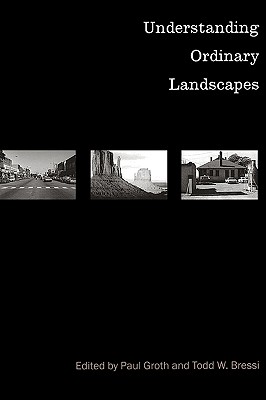
126: Groth & Bressi's Understanding Ordinary Landscapes

The essays in Paul Groth and Todd Bressi's collection Understanding Ordinary Landscapes are compiled from a two-day symposium at Berkeley in 1990 called "Vision, Culture, and Landscape" that was intended to both celebrate and critique JB Jackson's version of cultural landscape studies.  In general, while the essays underscore Jackson's reliance on and use of visual and spatial information as a way to understand past and present cultures, they grapple with ways to deal with the realities of social and cultural pluralism and their effects on the landscape.  While in many ways Jackson's work was radically subjective and Postmodern before its time, in others it is distinctly Modern, particularly in its emphasis on underlying universals, empirical research, and continuity.

According to Groth, cultural landscape studies defines landscape as the combination of people and place, with an emphasis on the history of how people have used everyday or vernacular space - buildings, rooms, streets, fields, yards - to establish and articulate identities, social relations, and cultural meanings.  When JB Jackson started publishing Landscape in 1951, he also emphasized the activist mission of cultural landscape studies: the more people know about ordinary environments, the more they will become attached to them and the less likely they will be to wantonly destroy them.  Groth and Bressi build on cultural landscape studies via a 6-part framework updated for the 1990s:

  1. focus on ordinary landscapes to get at cultural meaning and environmental experience
  2. shift from a rural emphasis to both rural and urban landscapes, as well as landscapes of production and landscapes of consumption
  3. continue to study diversity and uniformity, but emphasize difference, fragmentation, intertextuality and hybridity instead of a single, unifying narrative
  4. continue to write for the intelligent lay reader
  5. support a broad notion of interdisciplinarity that includes cultural, human, social, critical, landscape architecture, art history and other approaches
  6. engage with visual and spatial information, either in support of or in direct opposition to it; the landscape must remain the primary object of study.  Respect JB Jackson's argument that "landscape... must be regarded first of all in terms of living rather than looking."
This collection includes many heavyweights: David Lowenthal, Peirce Lewis, Dolores Hayden, Wilbur Zelinsky, and more - all folks who are contributing to and thinking about what a new cultural geography might mean and how it might be updated to include social difference and PoMo cultural theory.  It also holds up JB Jackson as the methodological exemplar of cultural landscape studies - which makes sense, because as far as I know, he invented it.

125: Kenneth Foote's Shadowed Ground

In Shadowed Ground: America's Landscapes of Violence and Tragedy, Kenneth Foote examines the treatment of spaces of violence and tragedy in the US to see how the relationship between private grief and larger national narratives is encoded and shaped by the landscape.  His (many) case studies include the Revolutionary and Civil Wars; the first slave arrival (in 1619), mass murders, political assassinations, violent labor and race riots, transportation accidents, fires, floods, and explosions; he argues that "the decision to render sites visible/ invisible reflects a deliberate choice regarding issues of meaning and identity."  Shadowed Ground thus contributes not just to the recovery of American history in the landscape, but to the exploration of the relationship between space and memory.

Foote argues that responses to tragic sites generally fit somewhere along this continuum, keeping in mind that the categories are not fixed:

124: Duncan & Duncan: Landscapes of Privilege

In Landscapes of Privilege: The Politics of the Aesthetic in an American Suburb, James Duncan and Nancy Duncan examine the landscape of Bedford, a wealthy community in Westchester County, to understand the relationship between aesthetics and the production of place and identities, and to think through the "wider social consequences of such an aestheticized view of the world."  Via interviews and first-hand landscape observation, they explore several interrelated issues:

  • "the ways people produce their identities in and through places, especially homeplaces, such as houses, gardens, and home communities," particularly some of the more “conservative, defensive attempts at using one’s surroundings to establish individual, family, and community identities…. against and in contrast to an outside world” or ‘constitutive outside.’
  • the effects, intended and unintended, of a virulent, reactionary politics of anti-development in Bedford in response to all the stars moving in and buying up properties
  • the role of Bedford landscapes as symbolic resources used in the quest for social distinction: how residents are invested in Bedford socially, psychologically, economically

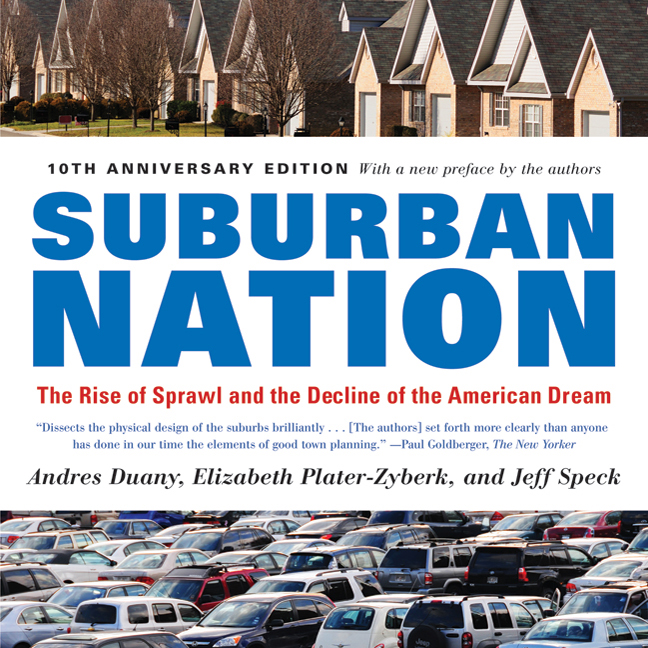
123: Duany, Plater-Zyberk & Speck's Suburban Nation

Despite its title, Suburban Nation: The Rise of Sprawl and the Decline of the American Dream, this book is only partially about suburbia; it also serves as a programmatic statement and justification for New Urbanist development.  Andres Duany, Elizabeth Plater-Zyberk and Jeff Speck are architectural and city planners who designed the planned community of Seaside, Florida, and throughout Suburban Nation they argue that suburban sprawl is not bad because it is ugly.  Rather, the authors (and their urban and suburban informants) argue that because there is a "causal relationship between the character of the physical environment and the social health of families and the community at large, suburbia is bad because it doesn't function to foster community and democracy.  By contrast, communities modeled after "traditional American neighborhoods" can be aesthetically pleasing, make more efficient use of space, and cater to the needs of both individuals and the community.

122: Mona Domosh's Invented Cities

In Invented Cities: The Creation of Landscape in Nineteenth-Century New York and Boston, Mona Domosh examines the historical, economic, and cultural origins of city development in Boston and New York.  Shows that in the 19th century, Boston and New York developed different spatial and architectural forms due to their different social/cultural structures, and that in both cases the physical and cultural structures mutually constituted the cities as different entities.  However, in both cities, the cultural landscape of the city represented its middle and upper classes, who produced "visible representations of their individual and group beliefs, values, tensions, and fears" on the urban landscape.  By applying a new cultural geography framework to urban landscape analysis, she brings 19th century urban development to life and shows how spatial patterns and culture shape one another.

121: Denis Cosgrove's Social Formation and Symbolic Landscape

From my notes from Spring 2012:

In Social Formation and Symbolic Landscape, Denis Cosgrove argues that the idea of “landscape constitutes a discourse through which identifiable social groups historically have framed themselves and their relations with both the land and with other human groups, and that this discourse is closely related epistemically and technically to ways of seeing.” (xiv) In other words, both humanistic and scientific approaches to landscape construct, represent, and interpret landscapes from a single, primarily visual, ideological perspective.  If this perspective is more invested in conveying the individual consumption of the landscape than in collective production of it, it also clearly articulates the construction of landscape and landscape discourse with power.

Cosgrove builds this argument through a history of the ‘landscape idea’ as it developed in Europe during the shift from feudalism to capitalism (from the Renaissance to the Industrial Revolution), where he subjects transitions in both physical construction of landscapes (from feudal manors and land-bound serfs to property and landless, mobile populations) and representation of landscapes (from landscape painting and maps to photography) to an analysis intended to break down the ideological emphasis on the visual and to reveal the collective social construction of landscape.  

115: Lucy Lippard's The Lure of the Local

Lucy Lippard's The Lure of the Local is a swan song to the hybridity of place - temporal and spatial, personal and political, geographical and psychological, lived and imagined, insiders and outsiders - and to the ways in which art, particularly public art, can mediate place's connections between land, history, and culture.  For Lippard, lived experience is central to the construction of place, as are the accumulated sedimentations of experience, memories, and connections in a place.  If space is a memoryless landscape, place is a landscape mediated by human experience.

In an increasingly globalized world, for Lucy Lippard, the "lure of the local" is

the pull of place that operates on each of us, exposing our politics and our spiritual legacies.  It is the geographical component of the psychological need to belong somewhere, one antidote to a prevailing alienation.  The lure of the local is that undertone to modern life that connects it to the past we know so little and the future we are aimlessly concocting.

Sunday, April 7, 2013

104: Don Mitchell's Cultural Geography

Don Mitchell's Cultural Geography: An Introduction is a critical introduction to cultural geography intended for graduate (or advanced undergraduate) students.  By "critical," Mitchell means a) he takes a normative position (here, informed by Marxism and materialism) and makes an argument, and b) he invites his readers to question, argue, and struggle with both the points he makes and the arguments behind them, because this kind of intellectual engagement will help us learn.  by "introduction to cultural geography," he means that the book explores the "struggles" that make "culture," both "to show how they get worked out in particular spaces and places - in particular landscapes - and to show how struggles over 'culture' are a key determinant, day in and day out, in the ways that we live our lives - and in what therefore constitutes significant cultural difference."  Culture, in Mitchell's formulation, is a relational process and is always political; the production of cultural space is thus the production of particular geometries of power that give shape and meaning to our lives.